" ... she was, just for an instant, ... impressed by her own arcane powers ... "
Reading Jincy Willett's wincingly comic novel, Amy Falls Down, I couldn't help but think of that Springsteen classic, "Glory Days." The gist of the song - and this book, in a way - is how strange we are to yearn for a past which we've painted gold, rather than engage with the present day.
Aren't we all, in the flush of some youthful success, impressed, just for an instant, by our own arcane powers?
Amy, the novel's main character, enjoyed a brief and minor celebrity - extremely brief and extremely minor - as a young writer, but has since slipped into a torpor where the closest she comes to writing is slowly filling a notebook with potential short story titles from snippets of phrases she catches in her dull days. She fears failure, and so she dare not risk trying - not beyond titles, anyway, titles which stare vacuously at us atop empty pages.
Perhaps it's just me, but I suspect it's a facet of the human condition to savor a glorious moment from our early days, once to be impressed by our own arcane powers, and thereafter to live in fear that we will never again achieve such heights, molehills though they might have been.
Amy, however, falls down. And bumps her head. On a birdbath.
From this accident, she rediscovers writing and is rediscovered as a writer - she is born again, albeit accidentally. She finds her voice, sings again, taking those infertile lists of story titles and opening them like umbrellas full of rain, pouring out words and ideas.
Can success then be a simple accident, a mishap, a misunderstanding? We'd like to claim our brilliance and industriousness brought us to greatness (such as our greatness is), but secretly we know that we benefited from forces outside our control and design. Maybe we should ban the concept of greatness from our vocabularies and philosophies, and just allow people to do what they do without being measured against some ridiculous list of eminent ones: Einstein, Picasso, et al.
What damage do we inflict upon our children by telling them "You can be the greatest, you can be the best," when we know that 99.99% of them will hover in the range of average accomplishments.
I read the obituaries every day, and even the most accomplished of our locally deceased will vanish to living memory once everyone who knew them passes on. Yet we yearn for greatness as the path to immortality. How silly.
No wonder this is a comic novel, for this is a comedic life.
Saturday, August 24, 2013

Saturday, August 10, 2013
Book Review: Neil Gaiman's The Ocean at the End of the Lane
Telling my son about Neil Gaiman's latest book, I struggled to come up with the essential adjective - you know, the way (Southern) "Gothic" describes Flannery O'Connor or "piquant" describes Christopher Hitchens.
I tried "eerie," but so much of the book was filled with hopeful longing, and the sweetness of childhood, that the word wilted the second it left my lips. All of its synonyms failed, as well: unearthly, otherworldly (though that one comes close), creepy, odd, freakish.
Yet Gaiman has given us scenes like this between a once-affectionate father and his seven year-old son:
I almost used ellipses to omit the paragraph describing the father's clothing, but realized that it was elemental to the scene's brilliance (and terror). The details: light blue shirt, maroon paisley tie, and the care he takes to spare his watch though not his child - these heighten the tension, as we already suspect that something horrible is about to happen. That descriptive break slows the pace and lets us inside the boy's innocent thoughts. And his feeling of weightlessness contributes to the effect, both thrilling and chilling, yet also hearkening back to his younger years when his father would have swept him up and carried him more often, and more affectionately. Brilliant. And terrifying.
Yet those adjectives, even in combination - or ghastly, shocking, appalling, and so on - ignore all the tender scenes refulgent with the beautiful innocence of childhood, as on the narrator's seventh birthday:
So we'd have to pair up contrasting descriptions, such as "warmhearted" and "eerie," but even then the pairing fails to show how tightly Gaiman interweaves the beauty and terror of the narrative. I suppose resistance to simple description makes a work worthy of our praise. And praise this work we must.
I tried "eerie," but so much of the book was filled with hopeful longing, and the sweetness of childhood, that the word wilted the second it left my lips. All of its synonyms failed, as well: unearthly, otherworldly (though that one comes close), creepy, odd, freakish.
Yet Gaiman has given us scenes like this between a once-affectionate father and his seven year-old son:
He didn't say anything in response. The bath was full, and he turned the cold tap off.
Then, swiftly, he picked me up. He put his huge hands under my armpits, swung me up with ease, so I felt like I weighed nothing at all.
I looked at him, at the intent expression on his face. He had taken off his jacket before he came upstairs. He was wearing a light blue shirt and a maroon paisley tie. He pulled off his watch on its expandable strap, dropped it onto the window ledge.
Then I realized what he was going to do, and I kicked out, and I flailed at him, neither of which actions had any effect of any kind as he plunged me down into the cold water.
I almost used ellipses to omit the paragraph describing the father's clothing, but realized that it was elemental to the scene's brilliance (and terror). The details: light blue shirt, maroon paisley tie, and the care he takes to spare his watch though not his child - these heighten the tension, as we already suspect that something horrible is about to happen. That descriptive break slows the pace and lets us inside the boy's innocent thoughts. And his feeling of weightlessness contributes to the effect, both thrilling and chilling, yet also hearkening back to his younger years when his father would have swept him up and carried him more often, and more affectionately. Brilliant. And terrifying.
Yet those adjectives, even in combination - or ghastly, shocking, appalling, and so on - ignore all the tender scenes refulgent with the beautiful innocence of childhood, as on the narrator's seventh birthday:
My parents had also given me a Best of Gilbert and Sullivan LP, to add to the two that I already had. I had loved Gilbert and Sullivan since I was three, when my father's youngest sister, my aunt, took me to see Iolante, a play filled with lords and fairies. I found the existence and nature of the fairies easier to understand than that of the lords. ...
That evening my father arrived home from work and he brought a cardboard box with him. In the cardboard box was a soft-haired black kitten of uncertain gender, whom I immediately named Fluffy, and which I loved utterly and wholeheartedly.
Fluffy slept on my bed at night. I talked to it, sometimes, when my little sister was not around, half-expecting it to answer in a human tongue. It never did. I did not mind.
So we'd have to pair up contrasting descriptions, such as "warmhearted" and "eerie," but even then the pairing fails to show how tightly Gaiman interweaves the beauty and terror of the narrative. I suppose resistance to simple description makes a work worthy of our praise. And praise this work we must.
Sunday, August 4, 2013
Book Review: I Wear the Black Hat by Chuck Klosterman
Klosterman subtitled his book, "Grappling with Villains (Real and Imagined)," and that word "grappling" aptly describes the tenor of this work. He wrestles with the concept of the bad guy as Jacob wrestled the angel: a somewhat confusing contest with no clear victor.
Early on, after conjuring up the classic picture of a villain as the man in the black hat who ties the pretty young woman to the train tracks, he defines a villain as someone who knows but does not care. It's a strange definition. Though it covers the greedy industrialist dumping chemicals into the river, it seems awfully passive - knowing, not caring - states of thought and emotion, rather than actions.
But I think Jesus would agree with this definition, however imperfect it might be. Evil comes from the heart, and the hands simply carry out its intentions. The man who looks at a woman with lust in his heart has already committed adultery with her. It is not what goes in a person, but what comes out, that poisons him. Yet the definition must be as flawed as our perceptions of what constitutes good and evil, and not only philosophically, but in the ways we live these concepts out in ways ranging from the music we loathe to the people who disgust us; and, conversely, the music and people we adore and admire.
Take a divisive figure like Bill Clinton. People will condemn and defend him for reasons political and moral, never convincing anyone to change their views.
Klosterman explains why we need to identify a villain in this case:
Perhaps we can return to Klosterman's original definition of a villain: someone who knows but does not care. Like a president who knows he compromises his office and legacy for the sake of some fleeting pleasure, but does not care. Like a young woman who knows she's doing something wrong but is too entranced by power to care. Like her friend who knows betraying someone for a moment of fame is wrong, but does not care. Like a lawyer who knows the whole charade is ultimately meaningless yet pursues it like a captial case just to inflict harm on the president's reputation. Like a wife who disregards her husband's philandering because she cares more about her own rise to power than this "loveless House of Cards agreement." But surely the villain should be Bill Clinton, yet he remains "the person who is perceived the least negatively" but "is the person who was the most irrefutably immoral."
But why? Klosterman blames it on our "looks-based, superficial society," and that we eagerly gloss over Clinton's indiscretions because he is (or, at least, was) one handsome devil, and he was smart enough to keep his mouth shut on the topic. It was Lewinsky, Tripp, Starr, and Hillary who tried to garner clout and advantage from the debacle, but Bill smartly shut up and moved on.
So our ideas of villainy - our very ethics - can be swayed by good looks, charm, and a good job of feigning innocence. It's not easy to know who's a villain when the bad guys refuse to wear the black hat.
Early on, after conjuring up the classic picture of a villain as the man in the black hat who ties the pretty young woman to the train tracks, he defines a villain as someone who knows but does not care. It's a strange definition. Though it covers the greedy industrialist dumping chemicals into the river, it seems awfully passive - knowing, not caring - states of thought and emotion, rather than actions.
But I think Jesus would agree with this definition, however imperfect it might be. Evil comes from the heart, and the hands simply carry out its intentions. The man who looks at a woman with lust in his heart has already committed adultery with her. It is not what goes in a person, but what comes out, that poisons him. Yet the definition must be as flawed as our perceptions of what constitutes good and evil, and not only philosophically, but in the ways we live these concepts out in ways ranging from the music we loathe to the people who disgust us; and, conversely, the music and people we adore and admire.
Take a divisive figure like Bill Clinton. People will condemn and defend him for reasons political and moral, never convincing anyone to change their views.
[Clinton is] the kind of man you could trust to lead the world, but not to drive your wife to the airport. He was a tireless, talkative, highly functioning sex addict. When his affair with Lewinsky was on the verge of exploding nationally, he continued to deny its existence to every single person he worked with ... If described to someone with no memory of the recent past, the villain in the Lewinsky scandal seems stupidly obvious ... It should be a simple equation. But it isn't. ... The larger vilification was ultimately split five ways. Mr. Clinton, of course, was first against the wall. But Monica Lewinsky was next, and she was hammered just as aggressively (and with much less justification). So was Linda Tripp, Lewinsky's comically untelegenic gal pal who coerced her into detailing the affair while secretly taping their phone conversations. So was Kenneth Starr, the obsessive lawyer who spent most of the nineties trying to destroy the Clinton administration and forced the American public to participate in his quest. And so was Hillary Clinton, a person who did nothing wrong ...So with the advantages of hindsight and distance from the turmoil of the news cycle, can we today peg the villain in Clinton's travails? Yes, each of us can, but each of us would do so differently and for differing causes. Some would make the argument that the question is moot - why stamp labels on these people, "good" or "bad," oversimplifying a highly nuanced story (which others would argue never should have made it beyond the Oval Office).
Klosterman explains why we need to identify a villain in this case:
[Clinton] lies about it to the entire world, is exposed as a liar (and admits this on television), is impeached by the House of Representatives, and jeopardizes both the reputation of the office and the memory of every positive thing he accomplished as president. It should be a simple equation. But it isn't. Clinton's impeachment worked to his short-term political advantage ... the public saw this as excessive and unjust.
Perhaps we can return to Klosterman's original definition of a villain: someone who knows but does not care. Like a president who knows he compromises his office and legacy for the sake of some fleeting pleasure, but does not care. Like a young woman who knows she's doing something wrong but is too entranced by power to care. Like her friend who knows betraying someone for a moment of fame is wrong, but does not care. Like a lawyer who knows the whole charade is ultimately meaningless yet pursues it like a captial case just to inflict harm on the president's reputation. Like a wife who disregards her husband's philandering because she cares more about her own rise to power than this "loveless House of Cards agreement." But surely the villain should be Bill Clinton, yet he remains "the person who is perceived the least negatively" but "is the person who was the most irrefutably immoral."
But why? Klosterman blames it on our "looks-based, superficial society," and that we eagerly gloss over Clinton's indiscretions because he is (or, at least, was) one handsome devil, and he was smart enough to keep his mouth shut on the topic. It was Lewinsky, Tripp, Starr, and Hillary who tried to garner clout and advantage from the debacle, but Bill smartly shut up and moved on.
So our ideas of villainy - our very ethics - can be swayed by good looks, charm, and a good job of feigning innocence. It's not easy to know who's a villain when the bad guys refuse to wear the black hat.
Tuesday, July 30, 2013
Book Review: The Icarus Deception by Seth Godin & Make Good Art by Neil Gaiman
This type of book thrives by stating the obvious emphatically. Advice tomes, self-help manuals, life & business inspiration. Have a taste, and see if you can guess which quotes are from Seth Godin ("one of the most popular business bloggers in the world") and which are from Neil Gaiman ("one of the creators of modern comics").
The odd numbered ones are from Gaiman; the even from Godin. But they all sound like they came from the same barrel of platitudes, from the shelves of AphorismMart. They're all true and yet like keys you find on the street - they don't open any doors you have to open. I like that metaphor: these self-evident truths are someone else's keys that don't work on your locks.
And yet I just read - eagerly - both of these works, and paid close attention, searching for ways to move closer to my distant mountains. I suppose there is something of a useful thrill, then, in finding someone's keys on the street, knowing that they open some door somewhere, taking hope that your keys must also be somewhere around here.
- "If you don't know it's impossible, it's easier to do."
- "An artist is someone who uses bravery, insight, creativity, and boldness to challenge the status quo."
- "Something that worked for me was imagining that where I wanted to be ... was a mountain. A distant mountain. My goal."
- "When you speak your truth, you have opened a door, allowing others to speak to you, directly to you, to your true self."
- "Life is sometimes hard. Things go wrong, in life and in love and in business and in friendship and in health and in all the other ways that life can go wrong."
- "Art has no right answer. The best we can hope for is an interesting answer."
- "So write and draw and build and play and dance and live as only you can."
- "Artists fail, and failing means that sometimes you need to change your mind about what you thought the best path might be."
The odd numbered ones are from Gaiman; the even from Godin. But they all sound like they came from the same barrel of platitudes, from the shelves of AphorismMart. They're all true and yet like keys you find on the street - they don't open any doors you have to open. I like that metaphor: these self-evident truths are someone else's keys that don't work on your locks.
And yet I just read - eagerly - both of these works, and paid close attention, searching for ways to move closer to my distant mountains. I suppose there is something of a useful thrill, then, in finding someone's keys on the street, knowing that they open some door somewhere, taking hope that your keys must also be somewhere around here.
Saturday, July 27, 2013
Book Review: Point Your Face At This - Drawings by Demetri Martin
Demetri Martin is mainly a stand-up comic, which explains the breed and brand of humor in his new book. Comics excel at examining the everyday expressions and behaviors we fail to examine, the phrases we hear and utter regularly without thinking, the things we do automatically, and, thus, the days we spend - the lives we live - without thinking. A good comic makes us think.
Take one of Martin's drawings in the book: it's a simple number line, running from -2 to 12. A bracket identifies the number set 5, 6, 7, 8 as "choreography." Think about it for a moment ... get it? Another drawing depicts, wordlessly across two pages, six drinking vessels that accompany our passage through life: baby bottle, fast food drink cup, beer stein, martini glass, tea cup, and little water cup with meds. I know the jokes probably don't work as well when described, but it is a book of drawings.


Take one of Martin's drawings in the book: it's a simple number line, running from -2 to 12. A bracket identifies the number set 5, 6, 7, 8 as "choreography." Think about it for a moment ... get it? Another drawing depicts, wordlessly across two pages, six drinking vessels that accompany our passage through life: baby bottle, fast food drink cup, beer stein, martini glass, tea cup, and little water cup with meds. I know the jokes probably don't work as well when described, but it is a book of drawings.
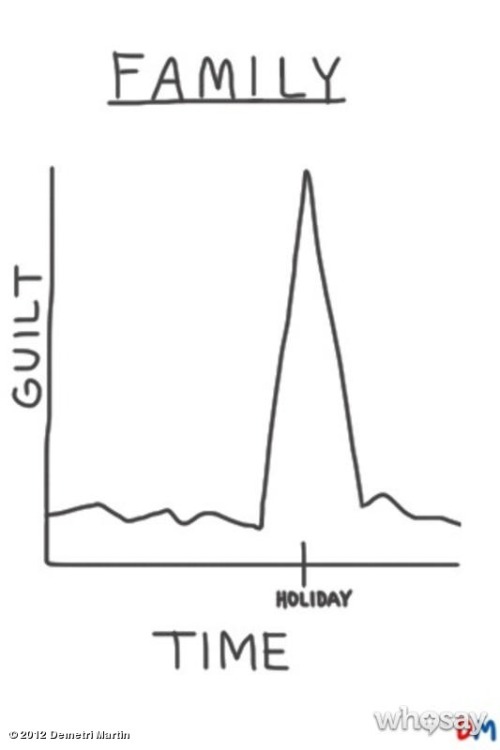
A section of the book includes charts and graphs such as this one. There's something inherently funny about turning something as non-mathematical as family guilt into a mathematical graphic that is, in its way, precise and insightful, more than most data-based charts. Other drawings take common expressions and look at them in a uniquely comic way.

Martin's book of drawings makes for hilarious but quick reading, so I recommend checking out his book of mostly writing, This Is a Book by Demetri Martin (yes, the title includes the attribution), which came out in 2011. Perhaps you already know him from his work on Comedy Central with The Daily Show and his own program, Important Things with Demetri Martin? If not, search out some video and take in as much of this wise guy who is quite a wise guy, whose dry, subtle humor might make you laugh out loud, but will more likely make you laugh - and think - in your head.
Monday, July 22, 2013
Book Review: Light & Shade - Conversations with Jimmy Page by Brad Tolinski
Grandma Romeo had given me some money for my birthday. I can't recall exactly how much or even which birthday it was. And I'm not sure if I ended up in the music section of Caldor or Bradlees, but I do remember one thing clearly.
My brother recommended using my precious funds to purchase my first record. I probably was only five or six years old, come to think of it, so the record had been out for a few years already. The record was Led Zeppelin's Houses of the Holy.
I spent the next few years enthralled by what we'd now call Classic Rock, a term I despise as it evokes a radio programming slot rather than the power it imparted to many a young mind. The same way RunDMC would grab me a decade later, and U2 shortly after that, Led Zep, along with Aerosmith and Black Sabbath and their ilk, allowed me to dream beyond the confines of ordinary life.
As a young guy, I preferred the more poppy tunes on the album: Dancing Days, D'yer Mak'er (the title of which I didn't get for many years). Now, the solemn, driving No Quarter and the moody Over the Hills and Far Away appeal more. But Led Zep shine has never faded in my heart and ears though my tastes have shifted away from rock n roll as I pass from youth to middle age.
Brad Tolinski's interview-based biography of Jimmy Page was, for me, then, like drawing back the curtain on the wizard of my childhood, but, unlike Dorothy, finding that there really was a wizard back there working the controls. Tolinski himself is an avowed fan, so if the book has any fault, it would be his unremitting praise even for some of Page's lackluster post-Zep projects, but I suppose we can forgive him that much if it buys us passages like this:
My brother recommended using my precious funds to purchase my first record. I probably was only five or six years old, come to think of it, so the record had been out for a few years already. The record was Led Zeppelin's Houses of the Holy.
I spent the next few years enthralled by what we'd now call Classic Rock, a term I despise as it evokes a radio programming slot rather than the power it imparted to many a young mind. The same way RunDMC would grab me a decade later, and U2 shortly after that, Led Zep, along with Aerosmith and Black Sabbath and their ilk, allowed me to dream beyond the confines of ordinary life.
As a young guy, I preferred the more poppy tunes on the album: Dancing Days, D'yer Mak'er (the title of which I didn't get for many years). Now, the solemn, driving No Quarter and the moody Over the Hills and Far Away appeal more. But Led Zep shine has never faded in my heart and ears though my tastes have shifted away from rock n roll as I pass from youth to middle age.
Brad Tolinski's interview-based biography of Jimmy Page was, for me, then, like drawing back the curtain on the wizard of my childhood, but, unlike Dorothy, finding that there really was a wizard back there working the controls. Tolinski himself is an avowed fan, so if the book has any fault, it would be his unremitting praise even for some of Page's lackluster post-Zep projects, but I suppose we can forgive him that much if it buys us passages like this:
Q: While "Immigrant Song" is built around a very straightforward, pile-driving riff, it's the subtle variations in it that make it more than just another hard-rock song. For example, toward the very end of the song, instead of playing a straight G minor for the accents, you play this very astringent inversion of that chord that really adds some bite. Where did that come from?Great to know that there really is magic in this world.
A: It's a block chord that people never get right. It pulls the whole tension of the piece into another area or another dimension just for that moment and a bit of backwards echo makes it a bit more complete. It's putting all these elements together that makes the music have depth. ... So to answer your question, where did that unusual G chord come from? I didn't have that chord when I started writing the "Immigrant Song," but it suddenly appeared while we were working together, putting on a massive brake to this machine. You know those old brakes where you clutch them and it just pulls out again, pulling it back in - that's how I see the function of that chord.
Saturday, July 20, 2013
Book Review: Food by Mary McCartney
I have no use for two types of cookbooks: the esoteric and the simplistic. I also dislike those which lack photographs of the completed dishes as much as those which overindulge in candid shots of hot chefs. Mary McCartney's collection of vegetarian recipes and photographs, then, is the perfect book: the recipes are challenging but won't cost you a hundred bucks in specialty items from every ethnic grocery in town, and, since her first calling is as a photographer, the photos illustrating the book are a tremendous and beautiful help in selecting and preparing meals.
I made a full, fancy meal from three recipes in the book: the eggplant wraps, quinoa & white bean soup, with coconut rice pudding for dessert. I did have to cough up a few extra bucks for fancy ingredients: pignoli (aka pine) nuts, quinoa, arborio rice, and sundried tomatoes, but all of these came in under $20 together and were available at my neighborhood supermarket.
The eggplant wraps were fantastic yet simple: wilted spinach, toasted pignoli nuts, and cheddar wrapped in a thick slice of fried eggplant. I love recipes where a vegetable substitutes in for bread; we once made tacos where a broad leaf of lettuce served as taco shell, and I don't think I've ever had better.
The quinoa & white bean soup was stomach- and heart-warming, but perhaps better suited for a winter's eve than a summertime brunch. The quinoa, however, seemed kind of useless for such a pricey item, and the soup would have been just as good with pastina in its place.
A chocolate sauce made the coconut rice pudding leap from the bowl rather than hunker gelatinously as pudding often does.
I did spend a good four hours preparing this big meal, so I wouldn't recommend constructing an entire menu from McCartney's book unless you have that time; also, the total grocery bill ran upwards of $50 just for this meal. However, one would do well to select a recipe once a week from this collection to try out something new and surely delicious. By the way, we had a vegan and two gluten-free eaters at this meal, and McCartney's recipes easily pleased everyone (though my son had his eggplant wraps minus the cheese). And a final note: yes, Mary McCartney is the daughter of Linda and Paul McCartney, a legacy she neither hides nor overemphasizes in the book, but pays respectful homage to, as many a cookbook author gives a nod to her forebears and influences.
I made a full, fancy meal from three recipes in the book: the eggplant wraps, quinoa & white bean soup, with coconut rice pudding for dessert. I did have to cough up a few extra bucks for fancy ingredients: pignoli (aka pine) nuts, quinoa, arborio rice, and sundried tomatoes, but all of these came in under $20 together and were available at my neighborhood supermarket.
The eggplant wraps were fantastic yet simple: wilted spinach, toasted pignoli nuts, and cheddar wrapped in a thick slice of fried eggplant. I love recipes where a vegetable substitutes in for bread; we once made tacos where a broad leaf of lettuce served as taco shell, and I don't think I've ever had better.
The quinoa & white bean soup was stomach- and heart-warming, but perhaps better suited for a winter's eve than a summertime brunch. The quinoa, however, seemed kind of useless for such a pricey item, and the soup would have been just as good with pastina in its place.
A chocolate sauce made the coconut rice pudding leap from the bowl rather than hunker gelatinously as pudding often does.
I did spend a good four hours preparing this big meal, so I wouldn't recommend constructing an entire menu from McCartney's book unless you have that time; also, the total grocery bill ran upwards of $50 just for this meal. However, one would do well to select a recipe once a week from this collection to try out something new and surely delicious. By the way, we had a vegan and two gluten-free eaters at this meal, and McCartney's recipes easily pleased everyone (though my son had his eggplant wraps minus the cheese). And a final note: yes, Mary McCartney is the daughter of Linda and Paul McCartney, a legacy she neither hides nor overemphasizes in the book, but pays respectful homage to, as many a cookbook author gives a nod to her forebears and influences.
Subscribe to:
Posts (Atom)