So, after a two month hiatus to welcome our baby into the world (thank you very much), "Head of the Class" is back, but with something different this week.
It only makes sense to write reviews of new books, but lately I've been reading some older titles, some only from last year, others decades old, and this week I'll pass those recommendations on to you.
I named our new boy Cormac Aran McGrath, which derived from and sent me back to two literary sources.
First was Cormac McCarthy. Previously I had only read Blood Meridian, The Road, and All the Pretty Horses. Returning to him now, many years later, I started by rereading Pretty Horses and then completing the Border Trilogy with The Crossing and Cities of the Plain. It's a strange sort of trilogy, where the second book has no character or plot connection to the first, and then the second pairs up the main characters from the first two books - more like a triptych than a trilogy, but one in which the story arc climbs higher throughout all thousand pages of the works. The overarching theme could be summarized as "what fools these mortals be." And then they die in a pool of blood.
No Country for Old Men fell within this same genre and feel. At times, you'd think this story was happening just down the road from John Grady's familial hacienda. No Country, however, seems more written for the movies, with an unsympathetic bad guy and more of a thriller plot line, slightly unoriginal (unsuspecting dude comes across a cache of drug money and keeps it, prompting the bad guys to pursue). It says a lot that you might as well just watch the movie for that one, whereas the movie of Pretty Horses is a complete waste of time and does no justice to the book.
Lastly, I added Child of God to my McCarthy roster as well, a shorter, more deliberately violent work, and honestly an earlier, immature work where the violence is less thematic and more ramped up for shock value, a sort of proto-Silence of the Lambs. You won't be missing much to miss this one.
I also circled back around to Stones of Aran, a two-work meditation on nature and history (both human and geological) by Tim Robinson. The first book, Pilgrimage, details his musings as he walks the perimeter of the largest of the three islands, Inishmor. For the second tome, Robinson turns inland and walks the Labyrinth of stone walls that define this tiny, harsh land. His writing bears that perfect balance of the scientific storyteller, and reading these books is like going on a trip. By the way, if I ever have the choice or chance, I would trade in my Savannah digs for a seaside cottage on Aran, a place I have never been but which Robinson taught me to love.
Besides my baby's namesakes, I read Jamie Quatro's collection of short stories, I Want to Show You More, a recommendation which came from, of all places, Runner's World magazine. She is a runner, you see, and has one story in this collection about running, a surreal tale that reads like a cross between a moral fable and a nightmare vision. Most or almost all the stories have character connections - the narrator of one story is the husband of another story's narrator, who appears as a passing minor character in yet another story, and so on. At first I found these connections enchanting, but about two-thirds through the book they grew annoying and frustrating, and I felt like I would have to read the book twice through for earlier stories to make complete sense - keep in mind that some of the stories (I think?) had no connection to the others. Overall, though, Quatro is a masterly writer, and I look forward to reading her in the future.
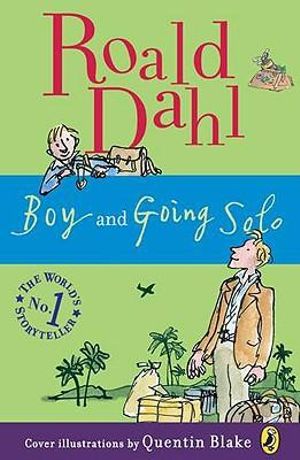
One of my favorite books of all time, Danny the Champion of the World, we are reading now in my fourth grade gifted class, which prompted me to pick up another book of Dahl's somewhat randomly, The Story of Henry Sugar and Six More. I read this one backwards, starting with the essay called "Lucky Break: How I Became a Writer," in which Dahl touches on his youth, schooling, and service in the RAF during WWII. The stories in this book, by the way, appear written for a younger audience, but only just so. Some are definitely for young adults or older adults. Anyway, the essay (which my students will read when we finish Danny) guided me to Dahl's two autobiographical works, Boy and Going Solo, which were quick, delightful reads. He did more by the end of his twenties than I'll probably do in my whole life. I've always admired Dahl as a writer, but add to that now a personal admiration.
Showing posts with label fiction. Show all posts
Monday, January 19, 2015
Friday, November 28, 2014
Book Review: California by Edan Lepucki and Station Eleven by Emily St. John Mandel
If anything distinguishes this era in literature, in the way that ennui amidst opulence marks the works of the Jazz Age or restless rambling marks the Beat Generation, it would be the fear of the collapse of civilization. This fear has spent the last several decades permeating all of popular media, bleeding over from the front page of the newspaper to our books, our movies, and our television. Can you still call it entertainment when what we read and watch stokes the fires of fear within us?
I have days when I think that we are really done for - that climate change (or war, or disease, or whatever) will hit a tipping point and then right and wrong, right and left, and even science and politics, will no longer matter, just the floods, the fires, and the famines. Then I think, Pshaw, we'll figure it out before all that happens. Then I think, But what if we don't.
Perhaps the best realization of these fears in literature and popular culture are the zombies, who are essentially us killing us to stop us from killing us. Colson Whitehead's Zone One captured this fear perfectly, and somewhat humorously, in his depiction of a last-ditch effort to contain the evil we create within ourselves, an evil that gradually externalizes and envelopes humanity in death. But sometimes the zombies aren't zombies, though they engage in that darkest taboo, cannibalism, as in Cormac McCarthy's The Road. If humanity makes it long enough to look back on this era, we will look back and herald McCarthy as the one who gave us a singularly unsurpassable portrait of post-apocalyptic survival and what it means to those who figure themselves (as we all do) the "good guys."
Two recent novels, California by Edan Lepucki and Station Eleven by Emily St. John Mandel, carry that dark fire onward. The works bear some striking parallels: both switch back and forth between the survival and pre-apocalyptic periods, both are more about what happens to relationships under strain than simple survival methodologies (two traits they share with The Road, and in which they differ from other popular stories in the genre). Both feature prophet figures (unlike The Road). And both hold up moral ambivalence to the light, turning it about in the hand like an object picked up on the shore, some strange object one tries to identify and comprehend.
Reading these works, I have to keep reminding myself that they are actually about how we are now, rather than how we will be in some poorly defined future (the apocalypse in Station Eleven comes by the "Georgia flu," which we need to know is highly contagious and incurable, and remains - again, as in The Road - unspecified in California). Not in the future, but now we are killing each other for convenience. Not after the apocalypse, but now we are simply surviving without really living. Not someday, but now we are destroying relationships with the people closest to us.
So all the zombie-slaying fun in popular culture misleads us, these works reveal. The apocalypse is now. The apocalypse will be televised. But it's not the Launcelotish romp with machete and rifle of a century hence we imagine, rather, it's the Quixotic foolishness of today. Looking at how these works end provides several insights as to whether we should hold out any hope for humanity. Whitehead finishes with imminent destruction; McCarthy with a small kindling of promise for those who "carry the fire." Station Eleven provides minor revelation and a slow shuffling on. But perhaps California is truest to human nature. Its heroes end up selling out, compromising themselves to death, a sort of carbon credit-trading of the soul. Is that where we're headed as a species? Maybe. But Lepucki is not so much concerned with that landscape. She's saying that we are already there now.
Sunday, November 2, 2014
Book Review: 100 Sideways Miles by Andrew Smith
100 Sideways Miles revels in all the stock characters and plot elements of the contemporary young adult novel the way politicians are sure to promise better schools and more jobs. In this election season, it gets to the point where you'd love to hear a candidate admit that his policies will have little effect on the economy, and that market forces are beyond the control of any one person or set of regulations. Similarly, I'd love to read a young adult novel that isn't The Fault In Our Stars Yet Again.
We have it all here: the main character who is perfectly ordinary, because we know, in our hearts, that we are perfect only in our ordinariness. However, we wish to be pitied, so the main character has some tragedy hampering his soul. That helps us feel misunderstood in our ordinariness (they just don't know how extraordinary I am). All you need then is a situation which thrusts the young person toward the fulfillment of his wishes. Oh, and he should get the girl and have an awesome best bud, because we'd like those things, too.
I could be describing anything from Star Wars to Harry Potter to The Hunger Games to TFIOS to this little YA outfit. At least two of those have redeeming qualities - J. K. Rowling, in particular, thrives on squeezing herself into a genre (witness her recent forays into pulp detective procedurals) and bursting out like that Mentos and Diet Coke thing.
So our mini-hero here is named Finn, and he is plain. He distinguishes himself in no way and is passionate about nothing. But, his mother was killed by a horse that fell off a train from a bridge and landed on their boat (really), an accident which also left him emotionally damaged and epileptic. He obsesses over the distance earth travels in space in its evolutions around the sun, and the relation of that distance to time as experienced on earth, which comes off as a heavy-handed and tiresome metaphor for, eh, um, something, I think. But all the parts of this pendulous clockwork are in place. Godlike best friend - check. Gets the girl. Loses the girl. Does something heroic. Gets the girl back. Check, check, check, and check.
100 Sideways Miles has some deeper elements which drove me to finish all 273 pages of its otherwise vapid drivel. The main character, Finn (not Huckleberry, by the way), has a dad who wrote an classic sci-fi novel loosely based on Finn's heterochromatic eyes and spinal scars, and Finn forever feels trapped in his father's book. That's a fascinating theme - the idea of a son feeling confined by his father's creation (which is, in a way, himself) - but the author is too busy dropping f-bombs, getting his characters drunk and explosively vomiting, and detailing their adolescent sexual misadventures (one of which is utterly ridiculous and even offensive - a German exchange student who lives to provide the godlike best friend with one-way gratification on a daily basis), much too busy with this mush to develop the one interesting thread in the book.
Then again, this book is merely indicative of what is wrong with YA fiction nowadays, and perhaps even of what is wrong with some (yes, some, only some) young adults: the distinctly modern self-centeredness that resembles living as if one were on a reality show. Some defects of adolescence are ingrained in our DNA, such as the foolhardy sense of invulnerability, but today's young adults - and the stories crafted for their demographic - reveal not only a staggering navel-gazing that permeates the culture, but also an awareness of this narcissism, which is shrugged off. Why bother caring about anything but your own desires? I suppose that's a question for us all.
Sunday, October 26, 2014
Book Review: Hold the Dark by William Giraldi
Reading Hold the Dark is like taking a trip back through your seventh-grade literature class, when you first discovered the mechanics of fiction. We have the gripping first line: "The wolves came down from the hills and took the children of Keelut." We have the heavy symbolism of wolves for all the evil inside us:
"They have the spirits of the damned."
"They're hungry wolves, hungry animals. Nothing more."
"I don't mean wolves."
"I'll go now," he said.
"Beware of false prophets, which come to you in sheep's clothing, but inwardly
they are ravening wolves."
"That's the Gospel of Matthew."
And so on. Also, Giraldi treats us to the classic Man vs. Nature theme which, in the spirit of Jack London, that seminal lover of the cold and stark setting, morphs into a Man vs. Man which in turn transfigures into that most human of conflicts, Man vs. Himself.
That brutal landscape (again, in the fashion of classic literature) expands into a character, a presence, a mysterious god whose force unleashes the primal violence and desire seated deep in our seemingly-civilized souls. The village itself is unbelievably named for a terrifying mythical demon dog. Besides the three children taken by wolves in the first paragraph, we have the story of a "girl mashed inside the digestive tract" of a wolf, the revenge killing of a wolf, and this surprisingly cheery, poetic description of wartime violence all within the first few pages:
The book turns on two unexpected plot twists, one regarding the supposedly wolf-taken boy from the first line, and a second involving the nature of the relationship between the boy's parents. That first twist is beautifully gruesome and breathtaking, but the second, coming in the final pages of the novel, is disappointingly corny and needless. It was a shame for Giraldi to end the story with a plot twist straight out of soap operas, after successfully painting such a lovely, stark image of love, evil, revenge, and desire. It would be as if "To Build a Fire" ended with the writer revealing that the main character had dreamed the entire story, or if 1984 had ended with Orwell explaining that Winston and Big Brother were actually brothers (a lá the ridiculous familial revelations in Star Wars).
However, Hold the Dark redeems itself in the person of Vernon Slone, a man's man who simultaneously attracts and repels us. Upon encountering one of his army buddies in the middle of raping an Afghan girl, Slone saves the girl. Such a hero, eh? Ah, but he does so by stabbing the soldier through the ear, a grisly salvation Giraldi depicts with his characteristic staid horror:
"They have the spirits of the damned."
"They're hungry wolves, hungry animals. Nothing more."
"I don't mean wolves."
"I'll go now," he said.
"Beware of false prophets, which come to you in sheep's clothing, but inwardly
they are ravening wolves."
"That's the Gospel of Matthew."
And so on. Also, Giraldi treats us to the classic Man vs. Nature theme which, in the spirit of Jack London, that seminal lover of the cold and stark setting, morphs into a Man vs. Man which in turn transfigures into that most human of conflicts, Man vs. Himself.
That brutal landscape (again, in the fashion of classic literature) expands into a character, a presence, a mysterious god whose force unleashes the primal violence and desire seated deep in our seemingly-civilized souls. The village itself is unbelievably named for a terrifying mythical demon dog. Besides the three children taken by wolves in the first paragraph, we have the story of a "girl mashed inside the digestive tract" of a wolf, the revenge killing of a wolf, and this surprisingly cheery, poetic description of wartime violence all within the first few pages:
When the .50-caliber rounds hit them they tore off limbs or else left dark blue holes the size of plums. He fired into those on the fuel-damp sand and those still crammed inside the truck's flattened cab. Their blood burst in the wind as wisps of orange and red. Curious how orange, how radiant blood looks beneath a desert non, in the dull even tinge of its light.And the body count and blood flow does not abate through the succeeding chapters. Giraldi appears to want to position himself as the Cormac McCarthy of the tundra, another sparse landscape and lawless terrain where the distinction between man and beast blurs in a stain of blood and brilliant sunsets.
The book turns on two unexpected plot twists, one regarding the supposedly wolf-taken boy from the first line, and a second involving the nature of the relationship between the boy's parents. That first twist is beautifully gruesome and breathtaking, but the second, coming in the final pages of the novel, is disappointingly corny and needless. It was a shame for Giraldi to end the story with a plot twist straight out of soap operas, after successfully painting such a lovely, stark image of love, evil, revenge, and desire. It would be as if "To Build a Fire" ended with the writer revealing that the main character had dreamed the entire story, or if 1984 had ended with Orwell explaining that Winston and Big Brother were actually brothers (a lá the ridiculous familial revelations in Star Wars).
However, Hold the Dark redeems itself in the person of Vernon Slone, a man's man who simultaneously attracts and repels us. Upon encountering one of his army buddies in the middle of raping an Afghan girl, Slone saves the girl. Such a hero, eh? Ah, but he does so by stabbing the soldier through the ear, a grisly salvation Giraldi depicts with his characteristic staid horror:
He stabbed this soldier through the right ear. A centimeter of the knife's tip poked through his left temple and Slone felt the body go limp on the blade. He held the man's drooped form upright with the knife so he would not topple on the girl. He then thrust him quickly back and yanked free the blade in the same even motion. The serrated side of the knife was crammed now with bone and brain.Yikes. The book, and Slone, rolls on in this manner, with stretches of snowy tension punctuated by storms of extreme violence. I found myself in the end, however, wanting to love this story as much as I loved those gems of seventh-grade literature - "The Necklace," "The Call of the Wild," "The Gift of the Magi" - but sadly, could not. I just wish some editor had talked Giraldi into polishing up the ending. Then his book, too, might have become assigned reading in schools, though likely not for seventh-graders.
Saturday, September 27, 2014
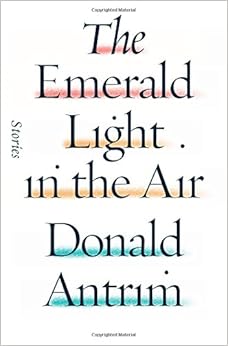
Book Review: The Emerald Light in the Air by Donald Antrim
We own little real estate in the small towns of our psychologies but two central ironies of modern life, like the post office and police station in our minds.
First, we think better of ourselves than we should. That's an understatement, perhaps. Second, we think we know ourselves, but we don't. Donald Antrim's stories play on these ironies like a San Francisco busker on an two-stringed erhu, sawing away at the awkward and self-defeating behaviors that resonate from our overestimation and ignorance of self.
Sometimes the effect is comic, as in this description of the genesis of an ill-fated outing in "Pond, With Mud."
In "Another Manhattan," the simple act of bringing flowers for his girlfriend at a restaurant date creates such abominable little tragedies that we feel for the poor sap who thinks flowers can fix relationships.
Antrim is also a master of the storytelling craft. specifically in his use of details that make an entire world real for his readers. In the title story, the main character starts out his debacle with a simple garbage run:
And that, ultimately, is the hypothesis of these stories: if we comprehend these people better than they know themselves, are we the same way? Do the people we know see through our masks? Are we all a bit like the emperor who was so sure not only of his clothing, but of his superior intelligence, while the children stand by laughing at our ridiculous bareness and barrenness? Can we not see beyond our noses because of that shimmering emerald light in the air?
First, we think better of ourselves than we should. That's an understatement, perhaps. Second, we think we know ourselves, but we don't. Donald Antrim's stories play on these ironies like a San Francisco busker on an two-stringed erhu, sawing away at the awkward and self-defeating behaviors that resonate from our overestimation and ignorance of self.
Sometimes the effect is comic, as in this description of the genesis of an ill-fated outing in "Pond, With Mud."
He had taken the afternoon off from his job at the printing press and gone with the boy in tow to catch the two o'clock train to the zoo that had recently opened on the outskirts of town, on marshlands that had been home to a chemical-solvent extraction plant that had burned to the ground. Immediately following the zoo's inaugural ribbon-cutting ceremony - or relatively soon after, to be more precise - strange things had begun to happen to the more esoteric wild animals. Why was it that the rare and endangered species, the ones you'd never heard of, all seemed to have compromised immune systems? At any rate, it had been reported in the papers that the board of governors and the director of the zoo were soon to come under indictment for cruelty to animals and for various misappropriations of municipal funds. The zoo's future was in question. The time for a visit was now.Now, the faulty logic at the paragraph's end does give us a chuckle, but it also gives us pause when we recall that the man will be visiting the zoo "with the boy in tow." Yet the details Antrim assembles generate an air of exaggeration that accentuates the humor: the incinerated chemical plant, animal cruelty at a zoo, embezzlement. Antrim's stories stand out from the trend among modern fiction writers to torture their poor creations precisely because he grants them some lightness to accompany the characters' unbearable being. The situations - grim, somewhat shocking - seem not so dark because of the dark humor Antrim wraps the plot in, like organ meat in clean butcher's paper.
In "Another Manhattan," the simple act of bringing flowers for his girlfriend at a restaurant date creates such abominable little tragedies that we feel for the poor sap who thinks flowers can fix relationships.
He parted the curtains. "Pardon me," he said to the people seated near the entrance. Long- and short-stemmed flowers alike had snagged on the drapes. ... Jim spun left then right, enshrouding himself - and the bouquet - within the folds of drapery fabric. There followed a flurry of petals. The rose thorns came loose; the bouquet's topmost stems sprung free. ... "You're bleeding," Lorenzo told him. Jim saw the blood spotting Lorenzo's handkerchief. Lorenzo said, "You have a lot of scratches. You look like you've been in a fight with some squirrels or something." ... He explained to Lorenzo that the flowers were a gift for Kate ... He clutched the vase. His pants were wet from water that had sloshed over the rim. Water stained his shoes. He could see tiny snags marking the sleeves of his overcoat and the front of his suit. How frustrating, after having labored so hard to avoid the thorns. His clothes would have to go to a reweaver, he thought. Then his thinking disintegrated into bitter resignation. Everything he touched was ruined. The flowers were almost destroyed.The scene plays like something out of Chaplin - indeed, most of Antrim's antiheroes smack of the Little Tramp, drained of any sentimentality. The antagonist in each story is none other than the man himself, the woman herself, and they all end up sounding like the Apostle Paul: "I do not understand what I do. For what I want to do I do not do, but what I hate I do."
Antrim is also a master of the storytelling craft. specifically in his use of details that make an entire world real for his readers. In the title story, the main character starts out his debacle with a simple garbage run:
... he was on his way to the dump to throw out the drawings and paintings that Julia had made in the months when she was sneaking off to sleep with the man she finally left him to marry, along with the comic-book collection - it wasn't a collection so much as a big box stuffed with comics - that he'd kept since he was a boy. He had long ago forgotten his old comics; and then, a few days before, he'd come across them on a dusty shelf at the back of the garage, while looking for a carton of ammo.How perfect a string of beads: the artwork, the infidelity, the comic books, a collection that is actually a pile, a forgotten childhood, a dusty search, a box of bullets. In two complex but ordinary sentences, we see deeper inside this man than he sees into himself.
And that, ultimately, is the hypothesis of these stories: if we comprehend these people better than they know themselves, are we the same way? Do the people we know see through our masks? Are we all a bit like the emperor who was so sure not only of his clothing, but of his superior intelligence, while the children stand by laughing at our ridiculous bareness and barrenness? Can we not see beyond our noses because of that shimmering emerald light in the air?
Saturday, September 6, 2014
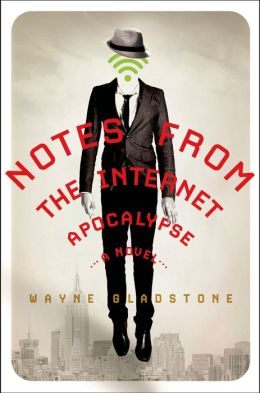
Book Review: Notes from the Internet Apocalypse by Wayne Gladstone
An internet apocalypse isn't really an apocalypse, is it? I mean, think about the book of Revelation:
When the Lamb opened the fourth seal, I heard the voice of the fourth living creature say, “Come!” I looked, and there before me was a pale horse! Its rider was named Death, and Hades was following close behind him. They were given power over a fourth of the earth to kill by sword, famine and plague, and by the wild beasts of the earth.
Now, that's an apocalypse. But the worldwide loss of the internet - especially as this novel conceives it, without any effect on international commerce - would primarily mean - as this novel conceives it - a loss of mindless entertainment. But wouldn't we treat it like an apocalypse? Our first world problems comprise a sort of daily apocalypse (my favorite is "My inflight movie was longer than my flight.").
Nowadays (I feel the curmudgeon rise within me, just using the word "nowadays" ... mmmmm ...) we can't just say something pithy. We tweet it. We aren't just proud of our children. We post their accomplishments on Fakebook, uh, I mean, Facebook. We can't just make a nice dinner for our family. We have to post it as food porn on Instagram. And I judge not, or at least I chuck the first stone at myself (which is just as difficult as it sounds) - I participate in this online solipsistic egofest. But, hey, I mean, like, hey.
So the main joke of this novel is how people would adapt to a world without Reddit and Twitter.
Tobey took a step closer. "First of all," he said, "I resent the implication that making up funny one-liners about how fat Jennifer Love Hewitt has gotten is not a real job. But more important, are you serious? Being a desk jockey for the Workers' Compensation Board? That's a real job? Judging from the amount of beer in your fridge and the fact that you're wearing jeans on a Tuesday, I'm guessing you haven't been there for a while."
"I'm working remotely," I lied.
"Working remotely or not even remotely working?" He smiled.
"Wow. That's a good one."
Tobey was the best two-paragraph blogger there ever was.
"I know. I just wrote that. And now it makes no sense because there's no Internet."
That's just it. What is the point of being clever if not to be appreciated, and to be thus valued by the largest audience possible, which has evolved to become a main function of the online world. Remember when the internet was new and everyone was flush with how it would change our lives? But no one predicted that LOL cats would rule and 6-second stop-motion animations on Vine would be hailed as high art. But this is the world we created, and we are stuck with it. Probably. Unless the internet stops working (or is stolen, by the government, of course).
Right. Which brings me back to this book. Three unlikely comrades go out in search for the internet as if it were a thing to be found. Which is the point. The internet is not a thing. In a sense, it's nothing. But here I am blogging about it. On the internet. Or blogging about the book (print on paper) about the internet on the internet. The snake chokes on its tail and takes a selfie while doing so (without hands, quite a trick).
Do they find the internet in the end? I don't know - does it really matter?
Saturday, August 23, 2014
Book Review: Colorless Tsukuru Tazaki and His Years of Pilgrimage by Haruki Murakami
We've all experienced it: you have a dream so vivid and affecting that you wander all day in and out of recollections of the dream and marveling at how perfectly it dovetails with your waking life. The sensible part of you reassures the speculative part that dreams don't really mean anything, that Freud has been largely debunked, and yet you can't shake the fog of dreams misting up before your eyes and making the air you breath a bit heavier.
Reading Haruki Murakami's Colorless Tsukuru Tazaki and His Years of Pilgrimage is much like that waking dream. Even the piece of music Murakami selects as the novel's theme (he always does, whether it's The Beatles or Janacek) is a murky piece oscillating between dream and life. The plot is simple: a middle-aged man seeks to discover why his four high school friends renounced him shortly after he left for college. The overarching theme seems to be the idea of reconciling with one's past, and yet Murakami cannot leave things so simple.
When your girlfriend gives you a tie, is it just a tie? After all, sometimes a cigar is just a cigar. But Murakami is a master at imbuing exchanges which appear dull with terrific meaning:
"Thank you. It's beautiful."
"Some men don't like to get ties as gifts."
"Not me," Tsukuru said. "I never get the urge to go out and buy a tie. And you have such good taste."
"I'm glad," Sara said.
Tsukuru removed the tie he'd been wearing, one with narrow stripes, and put on the one Sara had given him.
It's just a tie, right? However, their relationship ends on a strange note, unresolved, with Tsukuru suddenly overwhelmed by desire for her but Sara asking for a three-day break from their relationship. It's just a tie, right? Everything in this novel is a mysterious quasi-symbol subject to interpretation, as if we were at a Freudian dream-reading seminar.
Early on in the book he introduces a little mystery:
After trying out the piano, Midorikawa took a small cloth bag from his shoulder bag and gingerly placed it on top of the piano. The bag was made of expensive cloth, the opening tied up with string. Somebody's funeral ashes, maybe? Haida thought. It seemed like placing the bag on top of the piano was his habit, whenever he played. You could tell by the practiced way he went about it.
Having caught our interest, Murakami has his character ask about the bag:
"What is that bag?" Haida's father ventured to ask.
"It's a good-luck charm," Midorikawa said simply.
"Like the guardian god of pianos?"
"No, it's more like my alter ego," Midorikawa replied ...
It turns out that Murakami is building dreamlike layers of storytelling, taking us both further from the main story and deeper into it. The bag is a talisman, a "token," which grants the possessor a costly metaphysical "true sight." But this story belongs to Midorikawa, told to Haida's father, retold to Haida, retold to Tsukuru (and then, of course, retold to us by Murakami). These retellings lend the tale a folksy status, like Rowling's tales of Beedle the Bard, or, more significantly, like the retelling of a dream. This story-within-a-story (within a story, within a story) casts Tsukuru's otherwise pedestrian odyssey in a different light.
He is not simply searching the dim corners of the past for meaning, looking to turn a bad ending into a good one. He is trying to discover what is in the bag, and if it really allows the bearer to see the truth. Murakami ingeniously makes his main character a builder, but a builder of train stations, a man who creates the in-between places, the spots we do not really seek out but only pass through, the way places of life.
So we cannot trust the pat ending Murakami offers for the cursory reader, as when Tsukuru parts from one of his former friends:
"Thank you for coming all this way to see me," she said. "I can't tell you how happy I am that we could talk like this. I really feel like a great burden has been lifted, something that's been weighing me down forever. I'm not saying this solves everything, but it's been a huge relief."
"I feel the same way," Tsukuru said. "Talking with you has helped a lot. ..."
We end not with this seemingly happy ending, but with a whisper of doubt, a wind of wondering what's in the bag: is there a way to possess understanding of the truth in life, or will life always be like a dream we can't interpret?
He calmed himself, shut his eyes, and fell asleep. The rear light of consciousness, like the last express train of the night, began to fade into the distance, gradually speeding up, growing smaller until it was, finally, sucked into the depths of the night, where it disappeared. All that remained was the sound of the wind slipping through a stand of white birch trees.
What a perfect image of ungraspable nature of reality and dreams: a wind slipping through white birch trees. In the end of the book, then, as in life, we do not gain a peek into the bag.
Sunday, September 22, 2013
Book Review: & Sons by David Gilbert
I have finally put the pieces together. You see, for years I have forced myself to read long, rambling, pointless novels that I was not enjoying simply because the literary establishment hailed the writer as the latest and greatest. All along I figured something must be wrong with me - am I lacking literary sophistication? do I just not get it? But now I have put together the pieces of this puzzle, and am glad to announce what picture it forms.
Let's take David Gilbert's & Sons (yes, the ampersand is part of the title, which makes life difficult in this computer age - Amazon has it listed as "And Sons" and you can't tweet #&sons but must spell it out as #andsons - but I digress) along with two similar writers, Jonathan Franzen and Michael Chabon. You probably remember Franzen from his dispute with Oprah when he spat on her selection of his 2001 novel, The Corrections, for her book club; and perhaps you saw the film version of Chabon's Wonder Boys.
These three have much in common: rugged yet soft good looks (Chabon's crystal blue eyes account for 72% of his book sales, and that's A REAL STATISTIC), a high literary bent, and long, rambling works with frustratingly inconclusive and meaningless endings. (Their latest novels run an average of 554 pages.) And they win prizes. Franzen, for example, has collected the Pulitzer, the National Book Award, and even a coveted spot in Oprah's revamped book club (they made up a decade after their initial spat). I read Franzen's Freedom when it was the flavor of the month, Chabon's Wonder Boys a few years ago, and recently Gilbert's & Sons.
In all three cases, I suffered through their works like I would a trip to renew my license - tedious, barren, yet unavoidable. Several times I tried to read other works by these modern masters (Time magazine labelled Franzen the "Great American Novelist") but could not stand more than 50 or 100 pages before giving up to read something more interesting, like the new issue of Wired or the ad copy on the back of the store brand granola bars.
The characters in these novels all have horrible relationships with everyone around them, especially family, and the plot just plods along without the characters learning or changing or even recognizing their self-defeating foibles. Is that their point, then? That humans are doomed to egotistical futility? Seems so. Why, then, are these writers so highly acclaimed?
That's what Gilbert's work helped me decipher. You see, he and the others are superb wordsmiths - they can bang out sentence upon paragraph upon chapter of mellifluous prose. It really is high-flying poetic writing. But they are like potters who turn massive sculptures that, though technically exquisite, are repugnant and useless. & Sons, for example, culminates with the narrator shoving the object of his jealousy in front of a bus because, if he cannot be an insider in the family he idolizes (foolishly), then he will cut off its flowering branch so the whole tree withers. Really. That's how it ends. Oh, and the central character dies of old age without reconciling with any of the people he's hurt. Now, modern fiction need not moralize or teach Sunday school lessons, but this work lacks the scope of tragedy, comedy, or drama - it just slouches from boring event to boring event until there is no story left to tell.
I am now free. I no longer need force myself to read these high literary works which garner prize and praise for their beautiful prose when they leave the reader feeling drained of soul rather than filled. Don't get me wrong: I don't yearn for happy endings and neat tyings-up á la Dickens or Irving; I simply want to enjoy reading fiction, even with a troubled intellectual pleasure. Is that too much to ask?
Tuesday, September 10, 2013
Book Review: Mermaid in Chelsea Creek by Michelle Tea
The first recommendation for this book is its publisher: McSweeney's. No other publishing house today - or in any time - is so serious about literature, so quirky, so willing to invest in promising young authors, and so darned successful at doing so. Dave Eggers is their flagship writer, and their periodicals - the Quarterly Concern and The Believer - define innovation in both writing and design. And if you enjoy laughing so uncontrollably that chocolate milk shoots out of your nose even though you're not drinking chocolate milk, you must check out their Internet Tendency.
Michelle Tea's Mermaid in Chelsea Creek is perfect for McSweeney's because it defies categorization. Much like Neil Gaiman's last book, The Ocean at the End of the Lane, Mermaid has all the trappings of a young adult title but is far more disturbing than what we'd want our young ones reading (at least I think, but in these days of Twilight and such, maybe that red line has shifted as well). We have a young girl as the main character, an ordinary girl who discovers that she actually comes from a secret lineage of magical beings - a pretty common theme from Harry Potter to, um, other stuff like that.
However, the story owes a much larger debt to Neil Gaiman, and through him, to Diana Wynne Jones - indeed, even the main character's name, Sophie, comes straight from Howl's Moving Castle.
Stranger, though, was when I jumped to Michelle Tea's wikipedia page to learn a little more about the author. At first I thought, oh, this must be someone else with the same name because this person "toured with the Sex Worker's Art Show" and "is the co-writer of the weekly astrology column Double Team Psychic Dream." Couldn't possibly be the author of this delightful YA novel, however disturbing it may be at times. But it is the same person. Oh. Interesting.
On an unrelated note, my one gripe with this book - surprising given the publisher's high standards for design - is the horrendous quality of the illustrations. They appear to have been drawn by someone who simply cannot draw - each depiction of Sophie looks rather different from the rest, and his depictions of pigeons are so strained you can see the sweat drips on the page. Illustrator Jason Polan's wikipedia page brags that he has been published in The New Yorker, but that was a single cartoon back in 2006 - something I'm sure his mother was quite proud of, but he's no James Thurber, and that's saying an awful lot.
But back to the book. Mermaid is best suited for adults like you and I who now and then need to put aside Syria and global warming and our tribulations at work and home and indulge in a sweeping, gripping fantasy. It veers off course unexpectedly and ends up galaxies away from where it seemed to be headed. And it starts right on page one. Sophie and her quasi-friend Ella are playing the pass-out game, where they take turns helping each other asphyxiate into unconsciousness. While buzzing back to the world, Sophie sees a mermaid in the horribly polluted creek, and then is struck by a strange desire:
So right on the first few pages we have several things we wouldn't want our daughters doing, but written in the most captivating manner imaginable. And that's the core of this book - the story truly captures your imagination and leaves you hungering for more; like Sophia and her salt craving, you'll find yourself tipping back the pretzel bag to enjoy the last, sharply stinging bits of this book. Fortunately, Tea has promised this to be the first in a trilogy, so we have those tangy treats to look forward to.
Michelle Tea's Mermaid in Chelsea Creek is perfect for McSweeney's because it defies categorization. Much like Neil Gaiman's last book, The Ocean at the End of the Lane, Mermaid has all the trappings of a young adult title but is far more disturbing than what we'd want our young ones reading (at least I think, but in these days of Twilight and such, maybe that red line has shifted as well). We have a young girl as the main character, an ordinary girl who discovers that she actually comes from a secret lineage of magical beings - a pretty common theme from Harry Potter to, um, other stuff like that.
However, the story owes a much larger debt to Neil Gaiman, and through him, to Diana Wynne Jones - indeed, even the main character's name, Sophie, comes straight from Howl's Moving Castle.
Stranger, though, was when I jumped to Michelle Tea's wikipedia page to learn a little more about the author. At first I thought, oh, this must be someone else with the same name because this person "toured with the Sex Worker's Art Show" and "is the co-writer of the weekly astrology column Double Team Psychic Dream." Couldn't possibly be the author of this delightful YA novel, however disturbing it may be at times. But it is the same person. Oh. Interesting.
On an unrelated note, my one gripe with this book - surprising given the publisher's high standards for design - is the horrendous quality of the illustrations. They appear to have been drawn by someone who simply cannot draw - each depiction of Sophie looks rather different from the rest, and his depictions of pigeons are so strained you can see the sweat drips on the page. Illustrator Jason Polan's wikipedia page brags that he has been published in The New Yorker, but that was a single cartoon back in 2006 - something I'm sure his mother was quite proud of, but he's no James Thurber, and that's saying an awful lot.
But back to the book. Mermaid is best suited for adults like you and I who now and then need to put aside Syria and global warming and our tribulations at work and home and indulge in a sweeping, gripping fantasy. It veers off course unexpectedly and ends up galaxies away from where it seemed to be headed. And it starts right on page one. Sophie and her quasi-friend Ella are playing the pass-out game, where they take turns helping each other asphyxiate into unconsciousness. While buzzing back to the world, Sophie sees a mermaid in the horribly polluted creek, and then is struck by a strange desire:
Suddenly, Sophie craved salt. In the dry cave of her mouth, down her throat, which felt strange and thick, into her tumbling tummy, she craved a bag of pretzels, the rocky salt collected at the bottom, tipped straight back into her mouth - the reward, she thought, for polishing off the snack. ... Faster than her best friend could cry out in disgust, Sophie tugged her still-shimmering body to the edge of the water and plunged her face into it, mouth open, inhaling the dirty creek into her, the perfect, necessary salt of it obliterating the darker flavors of things she'd rather not think about. The sharpest taste, salt; she felt it travel through her like a delicious knife, the shock of it cutting through her, making her want more more more. She sucked at the creek hungrily, like a wild animal digging into its kill ...
So right on the first few pages we have several things we wouldn't want our daughters doing, but written in the most captivating manner imaginable. And that's the core of this book - the story truly captures your imagination and leaves you hungering for more; like Sophia and her salt craving, you'll find yourself tipping back the pretzel bag to enjoy the last, sharply stinging bits of this book. Fortunately, Tea has promised this to be the first in a trilogy, so we have those tangy treats to look forward to.
Saturday, August 24, 2013
Book Review: Amy Falls Down by Jincy Willett
" ... she was, just for an instant, ... impressed by her own arcane powers ... "
Reading Jincy Willett's wincingly comic novel, Amy Falls Down, I couldn't help but think of that Springsteen classic, "Glory Days." The gist of the song - and this book, in a way - is how strange we are to yearn for a past which we've painted gold, rather than engage with the present day.
Aren't we all, in the flush of some youthful success, impressed, just for an instant, by our own arcane powers?
Amy, the novel's main character, enjoyed a brief and minor celebrity - extremely brief and extremely minor - as a young writer, but has since slipped into a torpor where the closest she comes to writing is slowly filling a notebook with potential short story titles from snippets of phrases she catches in her dull days. She fears failure, and so she dare not risk trying - not beyond titles, anyway, titles which stare vacuously at us atop empty pages.
Perhaps it's just me, but I suspect it's a facet of the human condition to savor a glorious moment from our early days, once to be impressed by our own arcane powers, and thereafter to live in fear that we will never again achieve such heights, molehills though they might have been.
Amy, however, falls down. And bumps her head. On a birdbath.
From this accident, she rediscovers writing and is rediscovered as a writer - she is born again, albeit accidentally. She finds her voice, sings again, taking those infertile lists of story titles and opening them like umbrellas full of rain, pouring out words and ideas.
Can success then be a simple accident, a mishap, a misunderstanding? We'd like to claim our brilliance and industriousness brought us to greatness (such as our greatness is), but secretly we know that we benefited from forces outside our control and design. Maybe we should ban the concept of greatness from our vocabularies and philosophies, and just allow people to do what they do without being measured against some ridiculous list of eminent ones: Einstein, Picasso, et al.
What damage do we inflict upon our children by telling them "You can be the greatest, you can be the best," when we know that 99.99% of them will hover in the range of average accomplishments.
I read the obituaries every day, and even the most accomplished of our locally deceased will vanish to living memory once everyone who knew them passes on. Yet we yearn for greatness as the path to immortality. How silly.
No wonder this is a comic novel, for this is a comedic life.
Saturday, August 10, 2013
Book Review: Neil Gaiman's The Ocean at the End of the Lane
Telling my son about Neil Gaiman's latest book, I struggled to come up with the essential adjective - you know, the way (Southern) "Gothic" describes Flannery O'Connor or "piquant" describes Christopher Hitchens.
I tried "eerie," but so much of the book was filled with hopeful longing, and the sweetness of childhood, that the word wilted the second it left my lips. All of its synonyms failed, as well: unearthly, otherworldly (though that one comes close), creepy, odd, freakish.
Yet Gaiman has given us scenes like this between a once-affectionate father and his seven year-old son:
I almost used ellipses to omit the paragraph describing the father's clothing, but realized that it was elemental to the scene's brilliance (and terror). The details: light blue shirt, maroon paisley tie, and the care he takes to spare his watch though not his child - these heighten the tension, as we already suspect that something horrible is about to happen. That descriptive break slows the pace and lets us inside the boy's innocent thoughts. And his feeling of weightlessness contributes to the effect, both thrilling and chilling, yet also hearkening back to his younger years when his father would have swept him up and carried him more often, and more affectionately. Brilliant. And terrifying.
Yet those adjectives, even in combination - or ghastly, shocking, appalling, and so on - ignore all the tender scenes refulgent with the beautiful innocence of childhood, as on the narrator's seventh birthday:
So we'd have to pair up contrasting descriptions, such as "warmhearted" and "eerie," but even then the pairing fails to show how tightly Gaiman interweaves the beauty and terror of the narrative. I suppose resistance to simple description makes a work worthy of our praise. And praise this work we must.
I tried "eerie," but so much of the book was filled with hopeful longing, and the sweetness of childhood, that the word wilted the second it left my lips. All of its synonyms failed, as well: unearthly, otherworldly (though that one comes close), creepy, odd, freakish.
Yet Gaiman has given us scenes like this between a once-affectionate father and his seven year-old son:
He didn't say anything in response. The bath was full, and he turned the cold tap off.
Then, swiftly, he picked me up. He put his huge hands under my armpits, swung me up with ease, so I felt like I weighed nothing at all.
I looked at him, at the intent expression on his face. He had taken off his jacket before he came upstairs. He was wearing a light blue shirt and a maroon paisley tie. He pulled off his watch on its expandable strap, dropped it onto the window ledge.
Then I realized what he was going to do, and I kicked out, and I flailed at him, neither of which actions had any effect of any kind as he plunged me down into the cold water.
I almost used ellipses to omit the paragraph describing the father's clothing, but realized that it was elemental to the scene's brilliance (and terror). The details: light blue shirt, maroon paisley tie, and the care he takes to spare his watch though not his child - these heighten the tension, as we already suspect that something horrible is about to happen. That descriptive break slows the pace and lets us inside the boy's innocent thoughts. And his feeling of weightlessness contributes to the effect, both thrilling and chilling, yet also hearkening back to his younger years when his father would have swept him up and carried him more often, and more affectionately. Brilliant. And terrifying.
Yet those adjectives, even in combination - or ghastly, shocking, appalling, and so on - ignore all the tender scenes refulgent with the beautiful innocence of childhood, as on the narrator's seventh birthday:
My parents had also given me a Best of Gilbert and Sullivan LP, to add to the two that I already had. I had loved Gilbert and Sullivan since I was three, when my father's youngest sister, my aunt, took me to see Iolante, a play filled with lords and fairies. I found the existence and nature of the fairies easier to understand than that of the lords. ...
That evening my father arrived home from work and he brought a cardboard box with him. In the cardboard box was a soft-haired black kitten of uncertain gender, whom I immediately named Fluffy, and which I loved utterly and wholeheartedly.
Fluffy slept on my bed at night. I talked to it, sometimes, when my little sister was not around, half-expecting it to answer in a human tongue. It never did. I did not mind.
So we'd have to pair up contrasting descriptions, such as "warmhearted" and "eerie," but even then the pairing fails to show how tightly Gaiman interweaves the beauty and terror of the narrative. I suppose resistance to simple description makes a work worthy of our praise. And praise this work we must.
Thursday, July 4, 2013
Book Review: WARP - The Reluctant Assassin by Eoin Colfer
Full disclosure: I am an Eoin (pronounced "Owen") Colfer (pronounced "Colfer") fan.
I have read everything he's written, all fifteen or so young adult works, his handful of young readers, and his two novels for adults (well, three, really, counting his Part Six of Three continuation of Douglas Adams's Hitchhiker series). I got 30 copies of Artemis Fowl and made 35 of my students read it. I "liked" him on Facebook. We named our dog after him (though we spell it "Owen").
Moreover, I consider him a modern master; he can balance a swiftly developing, viscously convoluted plotline while drawing in precise detail fascinating and wildly different characters. His scenes remain embedded in your memory as if they had happened to you; you will see people in the park or grocery store and mistake them for his characters. Pardon me a second while I wipe the foam from the corners of my mouth.
Colfer is best known for his nine-book Artemis Fowl series, and this title marks the first in a new, open-ended series involving time travel between Victorian London (think Jack the Ripper) and the modern day. And my mentioning of Jack the Ripper is not accidental: the villain in this novel is the man who is such a murderous devil - Garrick - that he himself knifed Jack the Ripper just to show him up. Now that's a bad dude.
Witness how Colfer controls the tension in a particularly bloody scene:
Obviously, if you were expecting something cute and nifty along the lines of Spy Kids, you, too, like Turk, have been misled. I doubt Disney will be making this one into a movie any time soon - it would be the first NC-17 kids' movie ever.
But you can see, even in such a short passage from the center of the book. how Colfer shapes short-lived characters amidst a tense action scene - Turk's name, his silken slippers, his nickname for them, his scimitar, his darkly comic "I have been misled," his confusion as he dies - all these little touches delineate a character distinctive from the others (he is one of a trio sent to kill Garrick). Colfer makes this person real and living even as he kills him.
If you cannot bring your big adult self to read young adult fiction, no matter how masterly crafted, then go for Plugged or Screwed, Colfer's works for big people. However you go about it, step into one of his perfectly formed worlds and you'll find the boundaries of your world blown open.
I have read everything he's written, all fifteen or so young adult works, his handful of young readers, and his two novels for adults (well, three, really, counting his Part Six of Three continuation of Douglas Adams's Hitchhiker series). I got 30 copies of Artemis Fowl and made 35 of my students read it. I "liked" him on Facebook. We named our dog after him (though we spell it "Owen").
Moreover, I consider him a modern master; he can balance a swiftly developing, viscously convoluted plotline while drawing in precise detail fascinating and wildly different characters. His scenes remain embedded in your memory as if they had happened to you; you will see people in the park or grocery store and mistake them for his characters. Pardon me a second while I wipe the foam from the corners of my mouth.
Colfer is best known for his nine-book Artemis Fowl series, and this title marks the first in a new, open-ended series involving time travel between Victorian London (think Jack the Ripper) and the modern day. And my mentioning of Jack the Ripper is not accidental: the villain in this novel is the man who is such a murderous devil - Garrick - that he himself knifed Jack the Ripper just to show him up. Now that's a bad dude.
Witness how Colfer controls the tension in a particularly bloody scene:
Percival whistled two notes, high and low. The signal for Turk to advance from the folds of velvet curtain that concealed him.
Turk made even less noise than Percival, as he wore silken slippers, which he called his murder shoes. He came up on Garrick from the rear and reached out for a shoulder, to steady the magician for the scimitar's blade, but his questing fingers skinned themselves on glass instead of flesh and bone.
A mirror, thought Turk. I have been misled.
Terror sank into his gut like a lead anchor - he had the wit to know that he was done for.
The mirror image of Garrick reached out through the mirror and plucked Turk's own sword from his hand.
"You will not have need of this," said Garrick's image, and he plunged it directly into Turk's heart.
Turk died believing a phantasm had killed him.
Obviously, if you were expecting something cute and nifty along the lines of Spy Kids, you, too, like Turk, have been misled. I doubt Disney will be making this one into a movie any time soon - it would be the first NC-17 kids' movie ever.
But you can see, even in such a short passage from the center of the book. how Colfer shapes short-lived characters amidst a tense action scene - Turk's name, his silken slippers, his nickname for them, his scimitar, his darkly comic "I have been misled," his confusion as he dies - all these little touches delineate a character distinctive from the others (he is one of a trio sent to kill Garrick). Colfer makes this person real and living even as he kills him.
If you cannot bring your big adult self to read young adult fiction, no matter how masterly crafted, then go for Plugged or Screwed, Colfer's works for big people. However you go about it, step into one of his perfectly formed worlds and you'll find the boundaries of your world blown open.
Wednesday, June 12, 2013
Book Review: Nothing Gold Can Stay, stories by Ron Rash
A few stories into this collection of fourteen I found myself asking aloud, "How did I ever miss this guy?"
Rash hasn't exactly been obscure: he's won several prizes over a decade of publishing novels and short stories. But I hadn't ever come across his work before. Now I have everything he's written out from the library, stacked beside the couch for a glorious summer author study.
Nothing Gold Can Stay, as the title indicates, bears the heavy theme of decline and death - the cover art, a bare tree silhouetted grey on black before the moon of the "o" in "nothing" - captures the feel of the book perfectly. The same tree is featured on the spine, but in gold.
The story "Where the Map Ends" demonstrates the collection's verve. Two fugitive slaves - one older, one younger - spend the night in the loft of a barn, and wake to find the farmer has discovered them. Rash frames the tension beautifully:
A cowbell woke them, the animal ambling into the barn, a man in frayed overalls following with a gallon pail. A scraggly gray beard covered much of his face, some streaks of brown in his lank hair. He was thin and tall, and his neck and back bowed forward as if from years of ducking. As the farmer set his stool beside the cow's flank, a gray cat appeared and positioned itself close by. Milk spurts hissed against the tin. The fugitives peered through the board gaps. The youth's stomach growled audibly. ... The farmer did not look up but his shoulders tensed and his free hand clenched the pail tighter. He quickly left the barn.
The tension releases when the fugitives realize the farmer is not overly fond of their former master and therefore sympathetic to aiding their escape. But not entirely. The farmer sees traces of the slave master's red hair in the younger fugitive and directs all his antipathy for the war and wealth at this one, while aiding the older, African-born fugitive in his quest for freedom, leaving the elder slave to decide if he can abandon his youthful charge.
The people in Rash's stories are desperate, trapped by circumstances, and scrambling for release from their trials. Like the elder fugitive in "Where the Map Ends," they learn that freedom does not come without its burdens.
Monday, March 18, 2013
Book Review: Dave Barry's Insane City
I'm a little concerned about Dave Barry. I've long been a fan of his quirky, albeit predictable, humor: throw some asparagus into the toilet! set the cat's farts on fire! (and such), and have read approximately 33/42 of his books (approximately). But now I'm concerned.
I remember back in Big Trouble, Dave had these frogs whose skin, when touched, transmitted some hallucinogen (I think - I read that a while ago and may have been hallucinating myself). Now, in his new novel, Insane City, the main character is ... marijuana. Oddly, though, only one character (a very sweet, lovable girl) every lights up a doobie - mostly, the characters indulge in pot brownies. And the drug use turns crusty old men into avuncular buddy-types, and forges friendships across the usual socio-economic borders (yes! I went to college) that prohibit the superwealthy from even meeting, let alone sharing hashish with, Joe Six-Pack. Or is it Joe Dime-Bag?
So what is Dave getting at here? We all need to loosen up and pot is the way? At least in edible form? (He does gently wag a finger at inhaling, at least more than ten times a day.) I don't know, and I don't think Dave knows, either.
In any case, Insane City was a fun read that will keep you turning pages right to the totally formulaic cheesy romantic ending (Dave? Dave? I wouldn't do that if I were you), and the sitcom-friendly "everything worked out in the end" wrap-up (even the Haitian refugees get married and start on the path towards citizenship! not kidding!). Hey, we all need a break from Faulkner now and then.
Subscribe to:
Posts (Atom)