Showing posts with label teaching. Show all posts

Sunday, October 19, 2014

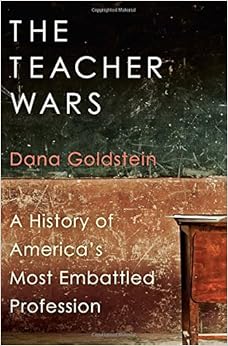
Book Review: The Teacher Wars by Dana Goldstein

     I’ll be honest: now is not the best of times to be a teacher.  When I see the inane dictates foisted upon the profession from the local, state, and federal level, or hear the vitriolic blame-gaming that passes for educational discourse in this country, it’s as if I’m underwater, holding my breath until a long storm above passes and it’s safe to surface.
In a strange way, then, Dana Goldstein’s book The Teacher Wars offers some comfort, cold though it may be.  The book reassures us that insanity and inanity have long served as the guiding forces in American education.

     Take one of my favorite policies to hate: merit-based pay.  A mere thirty years ago, within memory of today’s policymakers yet oddly forgotten, the seminal A Nation at Risk report created a sense of panic which spawned some idiotic and fortunately short-lived educational reforms, including merit-based pay.  And here we are - in the galvanized 21st Century - seeing this corpse of failure resuscitated.  Goldstein notes that, back in the 80s:
Twenty-four states claimed to have implemented some sort of “career ladder” rewarding teachers with merit pay, but by the end of the decade, almost all of those ladders had collapsed, weighed down by low budgets and lack of teacher buy-in (174).
Our own school district this year rolled out a merit-pay plan that offered an impressive-sounding (yet truly paltry) million dollars to be paid not to all teachers who hit a pre-defined educational target, but rather just to the top couple hundred (based on evaluations and test scores).  So teachers can have near-perfect evaluations and lead all their students in passing the state test … and get nothing.  Haven’t we learned?  Back in the 80’s, this type of system undermined morale more than it raised test scores.
There were several merit pay plans that were popular with teachers, and they had one major feature in common: Bonuses were available to every high-performing teacher in a school district, regardless of the grade level or subject they taught … [whereas] just 15 percent of teachers in Tennessee under Governor Lamar Alexander’s widely celebrated plan, and 10 percent of teachers in Florida [received bonuses] (176).
Assuming for a moment what is not true - that bonus money can buy you test scores - why on earth would you only buy a random percentage of teachers off instead of every one who could make the grade?  Well, I guess because money is expensive.

     Always in such things, when you have politicians (some of the deservedly least popular people in the country) determining what happens in classrooms, the law of unintended consequences kicks in and makes a mess of things.  And this cause and effect, Goldstein has found, rules the currents of American educational history and reform.  In the 1830s, reformers brought more women into the profession to, eh, save money, because, eh, women work for less than men.  We male teachers (and our sisters-in-arms) are just beginning to peel off the hair shirt of this legacy.  As Goldstein recounts the influence:
Yet during an era of deep bias against women’s intellectual and professional capabilities, the feminization of teaching of teaching wrought by the common schoolers carried an enormous cost: Teaching became understood less as a career than as a philanthropic vocation or romantic calling (31).
Even efforts we all support, such as integration, can wreak havoc for those meant to benefit from it.
Half the southern states passed laws revoking the teaching license of anyone who joined an organization that supported school integration, including the NAACP. …  Then, during the frustrated decade after Brown, desegregation was the law, but not the reality (112-113).
At least with desegregation, there was a cause worth suffering for.  But how about the race effects in recent and today’s reforms, where corporatizing efforts in the 1980s are being repeated today, with the same ill results?
This painful episode in American education history has generally gone unacknowledged by today’s accountability reformers, as they pursue policies, such as neighborhood school closings and school “reconstituitions” as charter or magnet schools, that lead disproportionately to the loss of teaching jobs held by African Americans. … When the [Chicago school] district reconstituted ten schools in 2012, 51 percent of the teachers dismissed were black, although black teachers make up only 28 percent of teachers citywide (122).
No Child Left Behind (NCLB) could easily be crowned King of unintended consequences.  The law meant to remove any opportunity for making excuses for failing students, but ended up harming exactly those it most intended to assist.
Teachers showered attention on so-called “bubble kids,” those right beneath the proficiency threshold, while ignoring the needs of high-ability students who would pass the tests no matter what, or low-ability ones who had little chance of rising to the proficiency bar (187).
And it wasn’t only teachers gaming the system during the troubled reign of NCLB.  States and school districts, too, played the numbers game like Fast Eddie Felson:
As a result [of a lack of the means to manage underperforming schools], many states followed the letter but not the spirit of the law and made their new tests absurdly easy for kids to pass.  In Texas a student who scored 13 percent was declared proficient (186).
One more example.  The biggest buzzword in the corporatizing of education today is “value-added,” which basically posits that a good teacher can be identified by measuring the value added to her students.  What it comes down to is using standardized test scores to evaluate the worth of teachers.  And how’s that working out?  Goldstein tells us.
When value-added is calculated for a teacher using just a single year’s worth of test score data, the error rate is 35 percent - meaning more than one in three teachers who are average will be misclassified as excellent or ineffective, and one in three teachers who excel or are terrible will be called average.  Even with three years of data, one in four teachers will be misclassified.  It is difficult, if not impossible, to compute an accurate value-added score for teachers who work in teams within a single classroom … or for the two-thirds of teachers who teach grades or classes not subject to standardized tests (206-207).
Goldstein is the first I’ve read to point out something I have long griped about - what if we fired all the low-scoring teachers?  Who is lining up to take their places?  “Good” teachers?
Even if test scores were a flawless reflection of student learning and teacher quality, there is no evidence that the new teachers who replace the bad teachers will be any better … (230).
The upshot is teachers, students, parents, and administrators with whiplash as reform after reform fails, and the new thing is ushered in as the, well, as the new thing (better than the old thing).  Meanwhile, generations of students pass through schools without any attention to what actually could be done to better their educations and life chances.

     So what is the ever-elusive fix?  Goldstein finds that, too, buried in the past, in the words of an unheeded social scientist of the 60s.
[Sociologist James] Coleman’s message was that although family income might be the biggest factor in student achievement, teachers and schools also mattered, especially for poor kids (121).
This whole-child approach echoes those espoused by Diane Ravitch and other independent reformers of today, who have no theory or party or politics in the game but only, genuinely, want to see America’s children receive the best possible education.  We have to fix poverty, health care, and … um … everything, kind of.  Yet even this realization is nothing new.  Witness Goldstein’s account of Johnson’s war on poverty as applied to schools in the Elementary and Secondary Education Act:
[President Johnson] signed ESEA in his hometown of Johnson City, Texas, with his own elementary school teacher at his side.  “By passing this bill, we bridge the gap between helplessness and hope for more than 5 million educationally deprived children,” he said.  “And we rekindle the revolution - the revolution of the spirit against the tyranny of ignorance (114).
The path to real and effective and lasting reform may be tricky and even treacherous, but the way is mapped out for us.  Teacher preparation programs, for instance, have historically been more a part of the problem than the solution.
Today only half of teacher candidates undergo supervised student teaching in a real classroom, and most teacher education programs have no mechanism for making sure mentor teachers are themselves successful or trained in how to coach an adult peer (248).
And what is the plan to better prepare teachers for the realities of the classroom?  Apparently, plenty of “blah, blah, blah,” but nothing significant.  And the wheel of history goes round and round.

     That repeating chorus of failure throughout the history of American education sounds at the heart of Goldstein’s book.  She maintains a professorial tone, but the occasional cracks in her journalistic veneer let shine through a witty light well worth waiting for.
The hope that collecting more test scores will raise student achievement is like the hope that buying a scale while result in losing weight (232).
Ultimately, Goldstein holds out hope that we can get our act together and see American education live up to its promise.  And, fortunately, she does see who will lead the way:
Effective teachers can narrow, but not close, achievement and employment gaps that reflect broader income, wealth, and racial inequalities in American society (208).
She also has gleaned, as in this quote from Larry Cuban of the Cardozo Project, how exactly teachers can turn the ship.
Simply stated, effective teaching is intimately related to how well a teacher knows who his charges are and the nature of their surroundings.  If he doesn’t, his perceptions will continue to be shaped by TV, newspaper, social science formulas, and fear - not by first-hand experience (128).

The book does - wisely - stop short of prescribing any cure-alls.  After all, Goldstein is a writer, not an educational expert.  (Though such lack of credentials fails to stop Bill Gates and even dabblers like M. Night Shyamalan from diagnosing and meddling in reform as far as their riches allow, which for Gates is pretty darn far.)  Reading this reform-minded history of American education, however, will inform your mind for the educational debate sure to accompany the next presidential race.  God help us.

Sunday, September 14, 2014

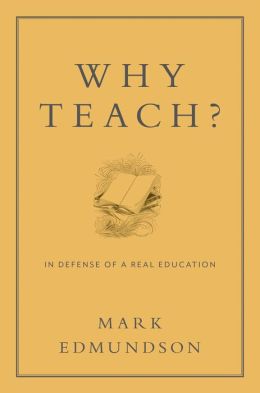
Book Review: Why Teach? by Mark Edmundson

No one does bitterness and scorn quite as well as old white guys, and no old white guys are so well equipped to express their discontent as college professors, hurling scrolls of invective from their ivory towers.  For most of this book, Why Teach? In Defense of a Real Education, Mark Edmundson does his pitch-perfect impression of the angry old white professor dude, but, then, the tone turns and becomes unexpectedly tender and personal.  For a short while.

Edmundson's main gripe is with what his beloved liberal arts university has become in the modern age.
In the old days, when the university was a quasi-churchly institution, the professors largely called the shots. ... But in the new university all this changed.  Now the professors were the people who gave the grades, period. ... anyone who revered them for their wisdom or wanted to emulate them was tacitly understood to be half-cracked (x).
As you'd expect, Edmundson is a university professor, and he dislikes his loss of prestige and power, to put it plainly.

Who's to blame?  The easy demon: society.
To me, liberal arts education is as ineffective as it is now ... [because] university culture, like American culture writ large, is, to put it crudely, ever more devoted to consumption and entertainment, to the using and using up of goods and images (6).
Well, then, we only need reverse the prevailing trend of American culture over the past three generations.  And a nice little book like this (ranked #396,984 in sales on Amazon) might just turn that tide (See?  I can be sarcastic, too!)

But Edmundson also blames the university itself, which in America (as we do all know) has become nothing more than a diploma mill where those who pay their tuition bills receive credentials in exchange, which they can then parley into money-making careers.  Still, he holds out hope for those little pockets of genuine education secreted throughout the country.
If you want to get a real education in America, you're going to have to fight ... against the institution that you find yourself in ... you'll need to struggle and strive, to be strong, and occasionally even to piss off some admirable people (52).
His pastiche of the "corporate city" type of university, bent solely on commerce and credentialization (yes, not really a word, but Mark will get the joke), is worthy of Mencken:
Universities that have made themselves into corporate cities are not hard to spot.  Most of the students - and many members of the faculty - are buzzing from place to place, always feeling a bit self-important, always feeling a bit behind, like that poor rabbit in Alice in Wonderland (107).
And the values they promote stand for similar biting review:
Why is excellence a bad word?  It's not, in and of itself.  But people around universities who use it are people who want to talk about worldly distinction without talking about ethics.  Excellence means we're smart, we're accomplished, we're successful - and we can be these things without any obligation to help our fellow human beings. ... Why is leadership so bad?  In itself, it's not.  But what people usually mean by a leader now is someone who, in a very energetic, upbeat way, shares all of the values of the people who are in charge (109).
But no one falls in line for harsher rebuking than the students themselves, in whom ever positive qualities betray an underlying stupidity.
... the reason that the kids are so open and appealing is that they're innocents.  Their naiveté is what's beguiling.  And part of what creates that innocence is ignorance.  They don't go from place to place pressed to the ground with the burden of the past - in part because they don't know much about that past (101).
Keep in mind that we are talking about college students at a prestigious university, "kids" who aced AP history courses, and Edmundson's depiction of them as grinning buffoons is all the more damning.  These "kids" are incapable of any intellectual discourse altogether.
It's this kind of dialogue, deliberate, gradual, thoughtful, that students immersed in the manic culture of Internet and Adderall are conditioned not to have (45).
So culture, the moneyed university, and the ignorant, complacent, drug-addled students have turned higher education into a sham, in Edmundson's view.

Then - and I know I've made you wait a while for it - the book turns.  Edmundson recalls the high school teacher, Mr. Meyers, who woke him from his unintellectual torpor and taught him that education is an act of rebellion.
Before Meyers arrived, I never rebelled against the place, at least not openly.  I didn't in part because I believed that Medford High was the only game there was.  The factories where my father and uncles worked were extensions of the high school; the TV shows we watched were manufactured to fit the tastes for escape that such places form; the books we were assigned to read in class, Ivanhoe, Silas Marner, The Good Earth, of which I ingested about fifty pages each, could, as I saw it then (I've never had the wherewithal to check back into them), have been written by the English teachers, with their bland, babbling goodness and suppressed hysterias (122).
Perhaps Edmundson's students, whose laptops are no longer welcome in his class since he discovered they were watching booty-shaking videos and emailing during class rather than taking notes, are a reflection of his younger self?  Maybe they see his book choices as he saw his teachers'?  Shockingly, this possibility does not occur to Edmundson.  But if, as he posits, education is an act of rebellion, then his students are rebelling effectively, against him and his worldview.

Verily, Edmundson seems to turn his firehose of vitriol on everyone but himself.  While on the cusp of self-discovery he backs away and returns to his comfortable weapons of sarcasm and high dudgeon, facetiously advising the imagined straw man of a new humanities professor:
... students believe it is up to the teacher to describe the book so appealingly (to advertise it, in short) that later in life, given leisure, they might have a look.  The summary and description should be carried on in a diverting way.  There ought to be copious reference to analogous themes and plots in recent popular culture.  Jokes ought to be offered at the expense of at least some of the characters, preferably all. ... In no event should the instructor hint that the author or the characters in the book are in any way superior to the students who have condescended to encounter them (145).
Indeed, Edmundson's greatest enemy appears to be the professor who does exactly thus, who tolerates a lowering of intellectual standards and embraces the familiar demon of pop culture.  He openly acknowledges his need to demonize.
Every essay on education needs a villain.  There has to be someone or something preventing the liberal arts from being the world-changing enterprise we all suspect they can be.  And I suppose so far I have supplied a few (203).
Ah, yes, Professor, you have supplied a few villains.  But I'm giving your book a C+ in that you propose no other hero than yourself, and you, Professor, cannot save education because education does not need saving.  Popular culture has always been a bane of lowbrow, mindless entertainment, but it is the intellectual's job to elevate these things by seeking to understand them rather than dismiss them, to write about baseball like Roger Angell, to write about Madonna like Camille Paglia, and to write about drug addicts like William T. Vollmann.

So I'll answer the book's question: Why teach?  We teach because we believe in deep thinking and the power of deep thinking and writing and reading to change the world in lasting, positive ways.  And we realize that we cannot do so by ourselves, and so we teach to train an army of thinkers - not to spurn and scorn them as dimwits, but to grab them by their souls and give them a good drubbing, saying, "Wake, sleeper, wake!  Wake and see what the world truly is!  See what you truly are!"


Sunday, August 31, 2014

Book Review: Getting Schooled by Garret Keizer

I never could bring myself to read all the way through books by alleged super teachers like Ron Clark and Rafe Esquith.  While they offer some sound advice (and their tomes are nothing but a patchwork quilt of pithy recommendations, often enumerated and always emphatic), their primary example of how a classroom should look and operate was their own, and at times the pointless bragging about going to the White House or having the president namedrop them in a State of the Union speech grew tiresome.  To be honest, it wasn't "at times" or "grew tiresome."  It was as consistently annoying as trying to lie out in the hammock on a pleasant day only to be pestered by mosquitos (a common occurrence here in Savannah).

Imagine, then, my relief at Garret Keizer's testimony to the triumphs and trials of teaching, where right on the first page he lays naked his shortcomings and aspirations:
It's fair to say that I have never gone to work in a school with what might be called purity of heart, though much of what I know about purity of heart I learned there.
Keizer second guesses not only local and federal policies and procedures, but turns his bitter, geezerly, cynical eye mainly on his own soul.  When he does stab at policy, however, it is delightfully mordant:
... throughout the school year, I will repeatedly be struck by the sense that the professed goal of creating 'a level playing field' through education is little more than the goal of sorting winners from losers with a steady hand and a clear conscience.  The single greatest expression of the American project, American public education is also its most cynical lie. ... I'm still straining to keep my mouth shut ... 
He also does not spare his students this raking analysis and dry commentary:
I have a small, highly cooperative lunch-period study hall, and a most delightful girl on the list, someone whose studiousness and affability seem to rub off on her neighbors.  One day she has nothing to do ... I ask her if she likes art.  Yes, she likes art very much.  Music to my ears - among several of the books I've brought to school for browsing is an expensive coffee table compendium of painting and sculpture by three Italian masters ....  The girl glances at the book without opening it.  'Thanks,' she says, 'but I guess I'll just draw,' by which she means penciling in the scribbled loops on a torn-out page of lined notebook paper.  So much for the Renaissance.
The running theme, then, is hypocrisy and the disappointment it engenders.  But, again, Keizer rifles through no one's corrupt morality more than his own.  When he mentally criticizes a troubled student for her sloppy work ethic, he immediately pulls out the whip for a round of self-flagellation:
     Not that I would say such a thing, and I'm not exactly pleased with myself for thinking it.  Even in this funky little tutorial I am reminded of how hard it it to predict when and how a girl or boy is going to catch fire. ... I'm reminded as well of how hard-won an achievement a kid's mere attendance can be relative to the forces keeping her down. ... And, perhaps, who knows, my greatest contribution to her life may be the remembrance of a single late afternoon when she glimpsed what it means to be part of a community of scholars.  It will be my fondest remembrance too: I know even as I'm sitting here that the year will hold nothing better than this.

So the drive to change lives and teach, to be a teacher, to teach students, lets go the accelerator and drifts off to settling for a single moment of semi-successful after school tutoring.  Keizer's honesty allows his greatest insight, that we cannot really be those plastic Ken doll National Teachers of the Year, hailed by presidents, book publishers, and motivational speaker bureaus alike.  We try, and we fail.  We cannot change every life with which we intersect, after all, but we do well enough to try, and to have those occasional moments of epiphany when we realize that Bob Marley was right, that we don't have to worry about a thing, because every little thing is gonna be alright.  Even if it really won't.


Tuesday, October 2, 2012

Down With Innovation!

Our school district superintendent is a fan of education writer Mike Schmoker.  I decided to give him a read on the basis of this recommendation and his awesome name.  Mike SCCCHHHHMMMMOOOOOOOKKKERRRRR.  Mike, if you're out there, I want to hang with you.  Can I call you Schmokey?

Anyway, here's a provocative yet surprisingly sensible quote from his book Focus, which I've only just started reading:

" ... the key to success is not innovation; it is "simplicity and diligence" applied with fierce devotion to our highest priorities" (p. 9).


I immediately thought of Ben Franklin and his worship of Almighty Industry (i.e., hard work).

Too often in schools we are caught up in the latest trend, only to discard them soon after.  So many cool things are inefficient at best and total time wasters at worst.  Let's make a list: Edmodo, centers, Reading First, educational board games, online educational games ...

None of these are a substitute for what Schmoker calls "authentic literacy."  Authentic literacy consists of reading, writing, and discussion.  Clicking through some nonsense on Starfall does not teach kids to read, and I will defend that assertion to my dying breath.  Otherwise, just replace us teachers with computers the way Edison thought his film projector would replace us.  The time-sucking nonsense does not teach kids to read and comprehend.  Teachers teach kids to read by teaching kids to read.

Simplicity and diligence.  Dig it, my brothers and sisters.  The Gospel of Schmoker.

Monday, June 18, 2012

Stick 'em

Relearned a lesson today.  A truism of sorts, among teachers.

My first day teaching in a summer program, I stuck tightly to the rules.  Like gum under a desk.  As they say, you can always loosen up, but you can't start loose and then get strict.

A good principle.

Sunday, May 27, 2012

How does your garden grow?

Today I finished up a Prezi on how gardening connects to science, math, and reading standards.

It was a lot of work.

Suffice it to say that you could teach much of what you need to teach in these subjects out in the garden.  Plenty of exceptions, sure, but most of the life science and earth science standards are out there.  The mistake we teachers make (me included, I confess) is teaching exclusively from textbooks and forsaking the hands-on experiences that make learning real.

Don't get me wrong - I'm an avid reader.  For example, I'm on a Bob Marley/reggae kick right now, and I've already consumed six books on the subject.  But I also learned a few Marley songs on guitar, and even tried my hand at writing a reggae tune of my own.

So I wouldn't say "Learn not from books," but rather, "Learn not from books alone!"

Saturday, May 26, 2012

My Other Students

Sometimes I'm so caught up in my work teaching that I forget who my real students are.

Who are the children I teach with every word, act, and omission?  Who hears me in the car and from the other side of the bathroom door?

Yep.  My kids.  So today I took the three of them out to the Forsyth Farmers' Market, then out to lunch, and then the SCAD Mini-Comics Expo.  We ran some errands, and then went to mass.  They learned a lot, and I remembered that DAD is more important than my BA or MAT or even my cherished TOTY.


Key: BA - undergrad degree; MAT - "Master of the Arts in Teaching," my graduate degree; TOTY - Teacher of the Year, which I earned this year, big fancy pants that I am.