Saturday, September 27, 2014

Book Review: The Emerald Light in the Air by Donald Antrim

We own little real estate in the small towns of our psychologies but two central ironies of modern life, like the post office and police station in our minds.

First, we think better of ourselves than we should.  That's an understatement, perhaps.  Second, we think we know ourselves, but we don't.  Donald Antrim's stories play on these ironies like a San Francisco busker on an two-stringed erhu, sawing away at the awkward and self-defeating behaviors that resonate from our overestimation and ignorance of self.
Sometimes the effect is comic, as in this description of the genesis of an ill-fated outing in "Pond, With Mud."
     He had taken the afternoon off from his job at the printing press and gone with the boy in tow to catch the two o'clock train to the zoo that had recently opened on the outskirts of town, on marshlands that had been home to a chemical-solvent extraction plant that had burned to the ground.  Immediately following the zoo's inaugural ribbon-cutting ceremony - or relatively soon after, to be more precise - strange things had begun to happen to the more esoteric wild animals. Why was it that the rare and endangered species, the ones you'd never heard of, all seemed to have compromised immune systems? At any rate, it had been reported in the papers that the board of governors and the director of the zoo were soon to come under indictment for cruelty to animals and for various misappropriations of municipal funds. The zoo's future was in question. The time for a visit was now.
Now, the faulty logic at the paragraph's end does give us a chuckle, but it also gives us pause when we recall that the man will be visiting the zoo "with the boy in tow."  Yet the details Antrim assembles generate an air of exaggeration that accentuates the humor: the incinerated chemical plant, animal cruelty at a zoo, embezzlement.  Antrim's stories stand out from the trend among modern fiction writers to torture their poor creations precisely because he grants them some lightness to accompany the characters' unbearable being.  The situations - grim, somewhat shocking - seem not so dark because of the dark humor Antrim wraps the plot in, like organ meat in clean butcher's paper.

In "Another Manhattan," the simple act of bringing flowers for his girlfriend at a restaurant date creates such abominable little tragedies that we feel for the poor sap who thinks flowers can fix relationships.
     He parted the curtains.  "Pardon me," he said to the people seated near the entrance.  Long- and short-stemmed flowers alike had snagged on the drapes. ... Jim spun left then right, enshrouding himself - and the bouquet - within the folds of drapery fabric.  There followed a flurry of petals.  The rose thorns came loose; the bouquet's topmost stems sprung free. ... "You're bleeding," Lorenzo told him.  Jim saw the blood spotting Lorenzo's handkerchief.  Lorenzo said, "You have a lot of scratches.  You look like you've been in a fight with some squirrels or something." ... He explained to Lorenzo that the flowers were a gift for Kate ... He clutched the vase.  His pants were wet from water that had sloshed over the rim.  Water stained his shoes.  He could see tiny snags marking the sleeves of his overcoat and the front of his suit.  How frustrating, after having labored so hard to avoid the thorns.  His clothes would have to go to a reweaver, he thought.  Then his thinking disintegrated into bitter resignation.  Everything he touched was ruined.  The flowers were almost destroyed.
The scene plays like something out of Chaplin - indeed, most of Antrim's antiheroes smack of the Little Tramp, drained of any sentimentality.  The antagonist in each story is none other than the man himself, the woman herself, and they all end up sounding like the Apostle Paul:  "I do not understand what I do.  For what I want to do I do not do, but what I hate I do."

Antrim is also a master of the storytelling craft. specifically in his use of details that make an entire world real for his readers.  In the title story, the main character starts out his debacle with a simple garbage run:
     ... he was on his way to the dump to throw out the drawings and paintings that Julia had made in the months when she was sneaking off to sleep with the man she finally left him to marry, along with the comic-book collection - it wasn't a collection so much as a big box stuffed with comics - that he'd kept since he was a boy.  He had long ago forgotten his old comics; and then, a few days before, he'd come across them on a dusty shelf at the back of the garage, while looking for a carton of ammo.
How perfect a string of beads: the artwork, the infidelity, the comic books, a collection that is actually a pile, a forgotten childhood, a dusty search, a box of bullets.  In two complex but ordinary sentences, we see deeper inside this man than he sees into himself.

And that, ultimately, is the hypothesis of these stories: if we comprehend these people better than they know themselves, are we the same way?  Do the people we know see through our masks?  Are we all a bit like the emperor who was so sure not only of his clothing, but of his superior intelligence, while the children stand by laughing at our ridiculous bareness and barrenness?  Can we not see beyond our noses because of that shimmering emerald light in the air?



Sunday, September 14, 2014

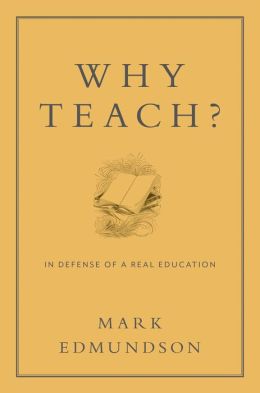
Book Review: Why Teach? by Mark Edmundson

No one does bitterness and scorn quite as well as old white guys, and no old white guys are so well equipped to express their discontent as college professors, hurling scrolls of invective from their ivory towers.  For most of this book, Why Teach? In Defense of a Real Education, Mark Edmundson does his pitch-perfect impression of the angry old white professor dude, but, then, the tone turns and becomes unexpectedly tender and personal.  For a short while.

Edmundson's main gripe is with what his beloved liberal arts university has become in the modern age.
In the old days, when the university was a quasi-churchly institution, the professors largely called the shots. ... But in the new university all this changed.  Now the professors were the people who gave the grades, period. ... anyone who revered them for their wisdom or wanted to emulate them was tacitly understood to be half-cracked (x).
As you'd expect, Edmundson is a university professor, and he dislikes his loss of prestige and power, to put it plainly.

Who's to blame?  The easy demon: society.
To me, liberal arts education is as ineffective as it is now ... [because] university culture, like American culture writ large, is, to put it crudely, ever more devoted to consumption and entertainment, to the using and using up of goods and images (6).
Well, then, we only need reverse the prevailing trend of American culture over the past three generations.  And a nice little book like this (ranked #396,984 in sales on Amazon) might just turn that tide (See?  I can be sarcastic, too!)

But Edmundson also blames the university itself, which in America (as we do all know) has become nothing more than a diploma mill where those who pay their tuition bills receive credentials in exchange, which they can then parley into money-making careers.  Still, he holds out hope for those little pockets of genuine education secreted throughout the country.
If you want to get a real education in America, you're going to have to fight ... against the institution that you find yourself in ... you'll need to struggle and strive, to be strong, and occasionally even to piss off some admirable people (52).
His pastiche of the "corporate city" type of university, bent solely on commerce and credentialization (yes, not really a word, but Mark will get the joke), is worthy of Mencken:
Universities that have made themselves into corporate cities are not hard to spot.  Most of the students - and many members of the faculty - are buzzing from place to place, always feeling a bit self-important, always feeling a bit behind, like that poor rabbit in Alice in Wonderland (107).
And the values they promote stand for similar biting review:
Why is excellence a bad word?  It's not, in and of itself.  But people around universities who use it are people who want to talk about worldly distinction without talking about ethics.  Excellence means we're smart, we're accomplished, we're successful - and we can be these things without any obligation to help our fellow human beings. ... Why is leadership so bad?  In itself, it's not.  But what people usually mean by a leader now is someone who, in a very energetic, upbeat way, shares all of the values of the people who are in charge (109).
But no one falls in line for harsher rebuking than the students themselves, in whom ever positive qualities betray an underlying stupidity.
... the reason that the kids are so open and appealing is that they're innocents.  Their naiveté is what's beguiling.  And part of what creates that innocence is ignorance.  They don't go from place to place pressed to the ground with the burden of the past - in part because they don't know much about that past (101).
Keep in mind that we are talking about college students at a prestigious university, "kids" who aced AP history courses, and Edmundson's depiction of them as grinning buffoons is all the more damning.  These "kids" are incapable of any intellectual discourse altogether.
It's this kind of dialogue, deliberate, gradual, thoughtful, that students immersed in the manic culture of Internet and Adderall are conditioned not to have (45).
So culture, the moneyed university, and the ignorant, complacent, drug-addled students have turned higher education into a sham, in Edmundson's view.

Then - and I know I've made you wait a while for it - the book turns.  Edmundson recalls the high school teacher, Mr. Meyers, who woke him from his unintellectual torpor and taught him that education is an act of rebellion.
Before Meyers arrived, I never rebelled against the place, at least not openly.  I didn't in part because I believed that Medford High was the only game there was.  The factories where my father and uncles worked were extensions of the high school; the TV shows we watched were manufactured to fit the tastes for escape that such places form; the books we were assigned to read in class, Ivanhoe, Silas Marner, The Good Earth, of which I ingested about fifty pages each, could, as I saw it then (I've never had the wherewithal to check back into them), have been written by the English teachers, with their bland, babbling goodness and suppressed hysterias (122).
Perhaps Edmundson's students, whose laptops are no longer welcome in his class since he discovered they were watching booty-shaking videos and emailing during class rather than taking notes, are a reflection of his younger self?  Maybe they see his book choices as he saw his teachers'?  Shockingly, this possibility does not occur to Edmundson.  But if, as he posits, education is an act of rebellion, then his students are rebelling effectively, against him and his worldview.

Verily, Edmundson seems to turn his firehose of vitriol on everyone but himself.  While on the cusp of self-discovery he backs away and returns to his comfortable weapons of sarcasm and high dudgeon, facetiously advising the imagined straw man of a new humanities professor:
... students believe it is up to the teacher to describe the book so appealingly (to advertise it, in short) that later in life, given leisure, they might have a look.  The summary and description should be carried on in a diverting way.  There ought to be copious reference to analogous themes and plots in recent popular culture.  Jokes ought to be offered at the expense of at least some of the characters, preferably all. ... In no event should the instructor hint that the author or the characters in the book are in any way superior to the students who have condescended to encounter them (145).
Indeed, Edmundson's greatest enemy appears to be the professor who does exactly thus, who tolerates a lowering of intellectual standards and embraces the familiar demon of pop culture.  He openly acknowledges his need to demonize.
Every essay on education needs a villain.  There has to be someone or something preventing the liberal arts from being the world-changing enterprise we all suspect they can be.  And I suppose so far I have supplied a few (203).
Ah, yes, Professor, you have supplied a few villains.  But I'm giving your book a C+ in that you propose no other hero than yourself, and you, Professor, cannot save education because education does not need saving.  Popular culture has always been a bane of lowbrow, mindless entertainment, but it is the intellectual's job to elevate these things by seeking to understand them rather than dismiss them, to write about baseball like Roger Angell, to write about Madonna like Camille Paglia, and to write about drug addicts like William T. Vollmann.

So I'll answer the book's question: Why teach?  We teach because we believe in deep thinking and the power of deep thinking and writing and reading to change the world in lasting, positive ways.  And we realize that we cannot do so by ourselves, and so we teach to train an army of thinkers - not to spurn and scorn them as dimwits, but to grab them by their souls and give them a good drubbing, saying, "Wake, sleeper, wake!  Wake and see what the world truly is!  See what you truly are!"


Saturday, September 6, 2014

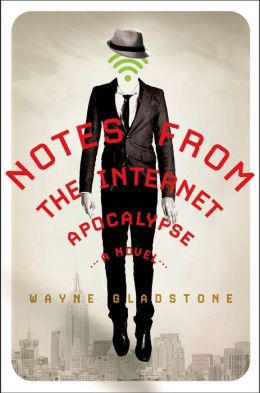
Book Review: Notes from the Internet Apocalypse by Wayne Gladstone

An internet apocalypse isn't really an apocalypse, is it?  I mean, think about the book of Revelation:
When the Lamb opened the fourth seal, I heard the voice of the fourth living creature say, “Come!” I looked, and there before me was a pale horse! Its rider was named Death, and Hades was following close behind him. They were given power over a fourth of the earth to kill by sword, famine and plague, and by the wild beasts of the earth.
Now, that's an apocalypse.  But the worldwide loss of the internet - especially as this novel conceives it, without any effect on international commerce - would primarily mean - as this novel conceives it - a loss of mindless entertainment.  But wouldn't we treat it like an apocalypse?  Our first world problems comprise a sort of daily apocalypse (my favorite is "My inflight movie was longer than my flight.").

Nowadays (I feel the curmudgeon rise within me, just using the word "nowadays" ... mmmmm ...) we can't just say something pithy.  We tweet it.  We aren't just proud of our children.  We post their accomplishments on Fakebook, uh, I mean, Facebook.  We can't just make a nice dinner for our family.  We have to post it as food porn on Instagram.  And I judge not, or at least I chuck the first stone at myself (which is just as difficult as it sounds) - I participate in this online solipsistic egofest.  But, hey, I mean, like, hey.

So the main joke of this novel is how people would adapt to a world without Reddit and Twitter.

     Tobey took a step closer.  "First of all," he said, "I resent the implication that making up funny one-liners about how fat Jennifer Love Hewitt has gotten is not a real job.  But more important, are you serious?  Being a desk jockey for the Workers' Compensation Board?  That's a real job?  Judging from the amount of beer in your fridge and the fact that you're wearing jeans on a Tuesday, I'm guessing you haven't been there for a while." 
     "I'm working remotely," I lied. 
     "Working remotely or not even remotely working?"  He smiled. 
     "Wow.  That's a good one." 
     Tobey was the best two-paragraph blogger there ever was. 
     "I know.  I just wrote that.  And now it makes no sense because there's no Internet."
That's just it.  What is the point of being clever if not to be appreciated, and to be thus valued by the largest audience possible, which has evolved to become a main function of the online world.  Remember when the internet was new and everyone was flush with how it would change our lives?  But no one predicted that LOL cats would rule and 6-second stop-motion animations on Vine would be hailed as high art.  But this is the world we created, and we are stuck with it.  Probably.  Unless the internet stops working (or is stolen, by the government, of course).

Right.  Which brings me back to this book.  Three unlikely comrades go out in search for the internet as if it were a thing to be found.  Which is the point.  The internet is not a thing. In a sense, it's nothing.  But here I am blogging about it.  On the internet.  Or blogging about the book (print on paper) about the internet on the internet.  The snake chokes on its tail and takes a selfie while doing so (without hands, quite a trick).

Do they find the internet in the end?  I don't know - does it really matter?


Sunday, August 31, 2014

Book Review: Getting Schooled by Garret Keizer

I never could bring myself to read all the way through books by alleged super teachers like Ron Clark and Rafe Esquith.  While they offer some sound advice (and their tomes are nothing but a patchwork quilt of pithy recommendations, often enumerated and always emphatic), their primary example of how a classroom should look and operate was their own, and at times the pointless bragging about going to the White House or having the president namedrop them in a State of the Union speech grew tiresome.  To be honest, it wasn't "at times" or "grew tiresome."  It was as consistently annoying as trying to lie out in the hammock on a pleasant day only to be pestered by mosquitos (a common occurrence here in Savannah).

Imagine, then, my relief at Garret Keizer's testimony to the triumphs and trials of teaching, where right on the first page he lays naked his shortcomings and aspirations:
It's fair to say that I have never gone to work in a school with what might be called purity of heart, though much of what I know about purity of heart I learned there.
Keizer second guesses not only local and federal policies and procedures, but turns his bitter, geezerly, cynical eye mainly on his own soul.  When he does stab at policy, however, it is delightfully mordant:
... throughout the school year, I will repeatedly be struck by the sense that the professed goal of creating 'a level playing field' through education is little more than the goal of sorting winners from losers with a steady hand and a clear conscience.  The single greatest expression of the American project, American public education is also its most cynical lie. ... I'm still straining to keep my mouth shut ... 
He also does not spare his students this raking analysis and dry commentary:
I have a small, highly cooperative lunch-period study hall, and a most delightful girl on the list, someone whose studiousness and affability seem to rub off on her neighbors.  One day she has nothing to do ... I ask her if she likes art.  Yes, she likes art very much.  Music to my ears - among several of the books I've brought to school for browsing is an expensive coffee table compendium of painting and sculpture by three Italian masters ....  The girl glances at the book without opening it.  'Thanks,' she says, 'but I guess I'll just draw,' by which she means penciling in the scribbled loops on a torn-out page of lined notebook paper.  So much for the Renaissance.
The running theme, then, is hypocrisy and the disappointment it engenders.  But, again, Keizer rifles through no one's corrupt morality more than his own.  When he mentally criticizes a troubled student for her sloppy work ethic, he immediately pulls out the whip for a round of self-flagellation:
     Not that I would say such a thing, and I'm not exactly pleased with myself for thinking it.  Even in this funky little tutorial I am reminded of how hard it it to predict when and how a girl or boy is going to catch fire. ... I'm reminded as well of how hard-won an achievement a kid's mere attendance can be relative to the forces keeping her down. ... And, perhaps, who knows, my greatest contribution to her life may be the remembrance of a single late afternoon when she glimpsed what it means to be part of a community of scholars.  It will be my fondest remembrance too: I know even as I'm sitting here that the year will hold nothing better than this.

So the drive to change lives and teach, to be a teacher, to teach students, lets go the accelerator and drifts off to settling for a single moment of semi-successful after school tutoring.  Keizer's honesty allows his greatest insight, that we cannot really be those plastic Ken doll National Teachers of the Year, hailed by presidents, book publishers, and motivational speaker bureaus alike.  We try, and we fail.  We cannot change every life with which we intersect, after all, but we do well enough to try, and to have those occasional moments of epiphany when we realize that Bob Marley was right, that we don't have to worry about a thing, because every little thing is gonna be alright.  Even if it really won't.


Saturday, August 23, 2014

Book Review: Colorless Tsukuru Tazaki and His Years of Pilgrimage by Haruki Murakami

We've all experienced it: you have a dream so vivid and affecting that you wander all day in and out of recollections of the dream and marveling at how perfectly it dovetails with your waking life.  The sensible part of you reassures the speculative part that dreams don't really mean anything, that Freud has been largely debunked, and yet you can't shake the fog of dreams misting up before your eyes and making the air you breath a bit heavier.

Reading Haruki Murakami's Colorless Tsukuru Tazaki and His Years of Pilgrimage is much like that waking dream.  Even the piece of music Murakami selects as the novel's theme (he always does, whether it's The Beatles or Janacek) is a murky piece oscillating between dream and life.  The plot is simple: a middle-aged man seeks to discover why his four high school friends renounced him shortly after he left for college.  The overarching theme seems to be the idea of reconciling with one's past, and yet Murakami cannot leave things so simple.

When your girlfriend gives you a tie, is it just a tie?  After all, sometimes a cigar is just a cigar.  But Murakami is a master at imbuing exchanges which appear dull with terrific meaning:
     "Thank you.  It's beautiful."
     "Some men don't like to get ties as gifts."
     "Not me," Tsukuru said.  "I never get the urge to go out and buy a tie.  And you have such good taste."
    "I'm glad," Sara said.
     Tsukuru removed the tie he'd been wearing, one with narrow stripes, and put on the one Sara had given him.
It's just a tie, right?  However, their relationship ends on a strange note, unresolved, with Tsukuru suddenly overwhelmed by desire for her but Sara asking for a three-day break from their relationship.  It's just a tie, right?  Everything in this novel is a mysterious quasi-symbol subject to interpretation, as if we were at a Freudian dream-reading seminar.

Early on in the book he introduces a little mystery:
     After trying out the piano, Midorikawa took a small cloth bag from his shoulder bag and gingerly placed it on top of the piano.  The bag was made of expensive cloth, the opening tied up with string.  Somebody's funeral ashes, maybe? Haida thought.  It seemed like placing the bag on top of the piano was his habit, whenever he played.  You could tell by the practiced way he went about it.
Having caught our interest, Murakami has his character ask about the bag:
     "What is that bag?" Haida's father ventured to ask.
     "It's a good-luck charm," Midorikawa said simply.
     "Like the guardian god of pianos?"
     "No, it's more like my alter ego," Midorikawa replied ... 
It turns out that Murakami is building dreamlike layers of storytelling, taking us both further from the main story and deeper into it.  The bag is a talisman, a "token," which grants the possessor a costly metaphysical "true sight."  But this story belongs to Midorikawa, told to Haida's father, retold to Haida, retold to Tsukuru (and then, of course, retold to us by Murakami).  These retellings lend the tale a folksy status, like Rowling's tales of Beedle the Bard, or, more significantly, like the retelling of a dream.  This story-within-a-story (within a story, within a story) casts Tsukuru's otherwise pedestrian odyssey in a different light.

He is not simply searching the dim corners of the past for meaning, looking to turn a bad ending into a good one.  He is trying to discover what is in the bag, and if it really allows the bearer to see the truth.  Murakami ingeniously makes his main character a builder, but a builder of train stations, a man who creates the in-between places, the spots we do not really seek out but only pass through, the way places of life.

So we cannot trust the pat ending Murakami offers for the cursory reader, as when Tsukuru parts from one of his former friends:
     "Thank you for coming all this way to see me," she said.  "I can't tell you how happy I am that we could talk like this.  I really feel like a great burden has been lifted, something that's been weighing me down forever.  I'm not saying this solves everything, but it's been a huge relief."
     "I feel the same way," Tsukuru said.  "Talking with you has helped a lot. ..."
We end not with this seemingly happy ending, but with a whisper of doubt, a wind of wondering what's in the bag: is there a way to possess understanding of the truth in life, or will life always be like a dream we can't interpret?
     He calmed himself, shut his eyes, and fell asleep.  The rear light of consciousness, like the last express train of the night, began to fade into the distance, gradually speeding up, growing smaller until it was, finally, sucked into the depths of the night, where it disappeared.  All that remained was the sound of the wind slipping through a stand of white birch trees.
What a perfect image of ungraspable nature of reality and dreams: a wind slipping through white birch trees.  In the end of the book, then, as in life, we do not gain a peek into the bag.


Tuesday, December 31, 2013

Book Review: The Childhood of Jesus by J. M. Coetzee

We all live like strangers in a strange land, trying to cobble together a sense of family and belonging, in the world of Coetzee's latest novel.

A man leaving his homeland for a new life takes on an abandoned boy - let's call him David, as his real name is lost - in order to help him locate his mother, or, rather, a mother.  He finds a candidate almost randomly and proposes the new family to her:

     "Let me be more precise," he says, speaking softly and rapidly.  "The boy has no mother.  Ever since we got off the boat we have been searching for her.  Will you consider taking him?"
     "Taking him?"
     "Yes, being a mother to him.  Being his mother.  Will you take him as your son?"
     "I don't understand.  In fact I understand nothing at all.  Are you suggesting that I adopt your boy?"
     "Not adopt.  Be his mother, his full mother.  We have only one mother, each of us.  Will you be that one and only mother to him?"

No wonder the man and boy read a children's version of Don Quixote together, the original modern novel, one where identity and belonging are confabulated with fantasy and misperception.  Coetzee's novel leaves you wondering if your concepts of self and your understanding of your role in your family and society are what you imagine, or perhaps we are, a bit like the knight-errant, suffering from flattering delusions.  In this work, as in life, there is neither a happy nor sad ending, nor an ending at all, just the steady onward sweep of days and hopes and searching.

Sunday, October 27, 2013

Book Review: Astonished by Beverly Donofrio

Maybe we can think of crimes more disturbing than rape, but there is no need.  Rape is horrible enough.

But I've never given rape much thought.  Why would I?  I know of no one close to me who has been raped, and as a regular American guy more focused on education and auto didacticism, I've had no reason to delve into this dark corner of the criminal psyche.

And I didn't see it coming when I picked up Beverly Donofrio's latest title, Astonished.  Her first two memoirs, the movie-famous Riding in Cars with Boys and then the quieter Looking for Mary, told her tales of self-defeating attempts to live freely and boldly, to find both excitement and solace in a confusing world.  Her rape, however, permeates this book like oxygen in the air.  It reminds me of a time I went on a plane trip and was too cheap to buy a rolling suitcase, opting instead for a heavy duffel bag I carried slung across my shoulder - not the kind of thing you can forget is burdening you with every step as you walk a mile from Gate A to Gate WW.

Donofrio begins the book by expressing her bewilderment that such unspeakable evil would visit her in particular:

Even though I do know the important question is not why this happened to me but what I'm going to do now ... I was absolutely shocked that he chose me.  This was not supposed to happen; I was supposed to have escaped: I had hot flashes and liver spots and was finally in the final stretch.  I'd survived all these decades without experiencing this thing I dreaded as much as death ... 
In the past month I've followed friends on Facebook as they went through similarly shocking bouts with evil: two young girls undergoing multiple surgeries after a car crash, and a highly respected, generous man having a brain tumor removed.  Though they never said as much, I'd guess they at some point asked the same question Donofrio asked, the same question Job asked: Why me?  That question seems to lie behind the books title: Astonished that evil would visit me - ME!

Fortunately, Donofrio circles around that question while still moving forward, searching for a monastery where she can take up residence, if not formal vows, to find a place of peace.  Astonished is something of a chick book, perfect for that demographic (female, middle aged, middle class, NPR listener, etc. - the dang cover is decorated with bracelet charms, for gosh sakes), but she is a talented enough writer to rise above the solipsistic memoir genre and speak from the soul about her quest for peace honestly.  Honestly - she admits when she is petty and judgmental, and not in the sordid reality-TV way we know so well, but with a downright saintly humility.

And yet the rape hovers over the book like a blimp at a football game (apologies for the incongruous metaphor).  Evil is not something we really recover from, when it strikes so personally and deeply; not something we get over.  Still, Donofrio convinces us, we can go on.  We can seek peace.  And maybe even find it.